The Museo de Trajes or Museum of Costume in Bogata, Colombia was a great visit for a fiber enthusiast like me. I was lucky to see the exhibits during a visit in 2017.
The posters (in Spanish of course) gave explanations of the goal of the museum, which is part of the University of America. Here is the essence of the posters in italics
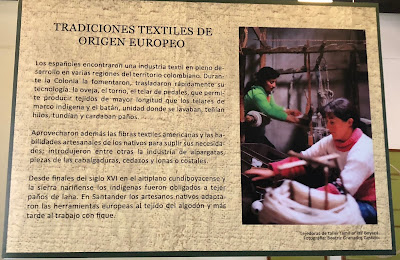
The Spaniards found a textile industry in full development in various regions of the Colombian territory. During the colonial period they promoted it, but also quickly imported their technology: the sheep, the winch(?), and the treadle loom, which allows production of fabrics of greater length than the indigenous frame looms. They also introduced shearing tools for sheep, and the fulling units where fibers were washed, carding tools, and spinning tools. They also took advantage of textile fibers (of the region) i.e. American fibers and the craftsmanship of the natives to meet their needs; they introduced among others the industry of espadrilles, "pieces of the mounts" (possible reins), sieves, canvas, and sacks. Since the end of the 16th century, in the Cundiboyacense highlands and the Narino sierra, the indigenous peoples were forced to weave woolen cloths. In Santander the artisans, natives, adapted the European tools to the cotton fabric and later to work with fique (sisal)
another poster noted that
The clothing speaks of the colonial regime, and ethnic and cultural mixing of the population. The Spanish crown appointed to its representative exclusive garments which were symbols of power. for whites, mestizos, black slaves, and natives. Many garments worn by the mestizos were simplified versions of the Spanish costume of the 16th and 17th centuries. These were made from natural materials: embroidered shirts, skirts, knee pants, and hats of vegetable fiber or felted wool and espadrilles. Other items like the ruanas, the muleteer (shoes of rope?), and the poncho, were closer to the pre-hispanic textile traditions. Wardrobes were created in the various geologic regions and adapted to environmental conditions. Traditional costumes in the museum were typical in Colombia up until 150 years ago, when development of roads plus industrialization allowed rural areas to be connected to national markets.
Here are samples of clothing from the exhibits, beginning with earlier indigenous costume. Photos were permitted, but of course were through glass.


It's interesting to note that the embroidered blouses, were a derivation of the "chemise" brought by the Europeans. I am fond of these garments that remind me of the embroidered "peasant" smocks that I wore in the 70's and 80's, a modern day garment-descendent


The posters (in Spanish of course) gave explanations of the goal of the museum, which is part of the University of America. Here is the essence of the posters in italics
The museum was founded in 1975 by the anthropologist Edith Himenez de Munoz. It is a place where costume and dress come together with consideration of the past, present, and future of costume. Pre-Hispanic dress and the European costume arrived with the Spaniards, and the resulting dress represents the mixing during the colonial times of indigenous peoples, Spaniards, and African population.
Also presented is the meeting of textiles traditions and crafts related to dress making, such as looms and various techniques present in America and others in Europe.

The Spanish explored Colombia in 1500 and began settlements early in that century, beginning with Santa Marta, Cartagena, what is now Sante Fe, and Cali.


The Spaniards found a textile industry in full development in various regions of the Colombian territory. During the colonial period they promoted it, but also quickly imported their technology: the sheep, the winch(?), and the treadle loom, which allows production of fabrics of greater length than the indigenous frame looms. They also introduced shearing tools for sheep, and the fulling units where fibers were washed, carding tools, and spinning tools. They also took advantage of textile fibers (of the region) i.e. American fibers and the craftsmanship of the natives to meet their needs; they introduced among others the industry of espadrilles, "pieces of the mounts" (possible reins), sieves, canvas, and sacks. Since the end of the 16th century, in the Cundiboyacense highlands and the Narino sierra, the indigenous peoples were forced to weave woolen cloths. In Santander the artisans, natives, adapted the European tools to the cotton fabric and later to work with fique (sisal)
another poster noted that
The clothing speaks of the colonial regime, and ethnic and cultural mixing of the population. The Spanish crown appointed to its representative exclusive garments which were symbols of power. for whites, mestizos, black slaves, and natives. Many garments worn by the mestizos were simplified versions of the Spanish costume of the 16th and 17th centuries. These were made from natural materials: embroidered shirts, skirts, knee pants, and hats of vegetable fiber or felted wool and espadrilles. Other items like the ruanas, the muleteer (shoes of rope?), and the poncho, were closer to the pre-hispanic textile traditions. Wardrobes were created in the various geologic regions and adapted to environmental conditions. Traditional costumes in the museum were typical in Colombia up until 150 years ago, when development of roads plus industrialization allowed rural areas to be connected to national markets.
Here are samples of clothing from the exhibits, beginning with earlier indigenous costume. Photos were permitted, but of course were through glass.


Note the molas used in costumes below; molas are thought of as Panamanian but are also made in Colombis


It's interesting to note that the embroidered blouses, were a derivation of the "chemise" brought by the Europeans. I am fond of these garments that remind me of the embroidered "peasant" smocks that I wore in the 70's and 80's, a modern day garment-descendent