Saturday, April 25, 2020

Ukrainians in Canada: The Ukranian Cultural Heritage Village; Ukrainian weaving

I love museums. When I travel (and when I don't) museums teach me so much about the culture and heritage of a place or a person. Museums, like churches, contain bits of people's souls. (I didn't come up with that, I wish I could remember who did). 

When I travelled to Alberta to visit my friend Barb in 2017, we made a quick decision to go to the Ukrainian Cultural Heritage Village. Ukrainians have been recorded as beginning to move to Canada starting in 1891, although it may have begun earlier than that, according to Wikipedia. Ukrainians comprise an East Slavic ethic group; one name for them is "Cossacks." They by and large Eastern Orthodox Christians. More from Wikipedia:  Canada has the third largest Ukrainian population in the world following Ukraine and Russia. There were of course political "push" factors encouraging immigration, as well as "pull" factors, notable Canada's desire to populate the unsettled areas of Manitoba and Alberta, although Ukrainians also emigrated and stayed in the eastern provinces as well. 

So when visiting Barb and driving around Edmonton, we made a quick decision to go to the museum. The museum was impressive with reenactors, and the different buildings represented different time periods of Ukrainian immigration. It was a wet rainy day and these arches were very welcoming.


Of course, we arrived at lunchtime and proceeded to the restaurant for a Ukrainian-Canadian feast of a lunch. I wish I could remember what it all was but it included kasha salad and some sausage. 


Here, Barb inspects a loom housed for renovation in a barn.


The weavings were stunning, bright and colorful. I am not sure whether what I photographed were kilims per se;  here is a site with information on Ukrainian kilim weaving.  (It's a nice read, regardless).


There were some lovely embroidered garments as well; this may have been a wedding blouse


Here is the church; I love the three crossbeams on the Russian Orthodox crosses. They can be seen throughout Canada especially in the west


This is St. Barbara


In one house, this young lady showed us a dress that she had sewn "for her sister." She had a credible Ukrainian accent but came "out of character" once on the porch to give us directions to our next stop as it was pouring rain. This home was circa 1929. 


  This Singer Electric sewing machine would have arrived on the train from the East.


 The town store, circa 1929


Trains were present in the early 20th century in rural Alberta.


It was a wet and muddy day but worth it! Barb made pierogies for breakfast the next morning!

Artist William Kurelek, one of whose works I saw in Halifax a couple of years later, is Ukrainian Canadian. I liked this painting so much I photographed it


Monday, April 20, 2020

FO: Cathedral Grove Shawl

I have a good friend who loves the KAL. We had two shawl KALs between us over the last year. Perhaps I will finish the first this year. The second however is done.  It is Romi Hill's Cathedral Grove.  I do love a good lace knit. It does feel like my happiest knitting place (if not the most functional sort of project...that leads me to not thinking about how many lace shawls I have finished...). The dark yarn is Malabrigo Sock, color Pocion. The wonderful rosey orange,  I have not clue. I had just enough to finish.


OK, that's it for now...I am not working at present and should have time to knit  but the garden keeps me busy, and I am determined to be a better iris gardener this year. Here is my first open of the year:  Iris Siberica, Caesar's Brother


Monday, March 2, 2020

Clementine Hunter

I visited the Gibbes Museum of Art  in Charleston this weekend and was delighted to see a work by an artist who I find inspiring.  The exhibit "Central to Their Lives: Southern Women Artists in the Johnson Collection" was featured.   The Johnson Collection is a gallery in Spartanburg SC, not far from where I grew up in Greenville.

Years ago, like more than 20, I went to New Orleans on a work trip (long after I had left Greenville for college and points beyond...my job was in Manhattan). I visited The Quarter Stitch, which at the time had more needlepoint than knitting. Looks like Katrina could not keep this shop down. At any rate, this visit was years before Katrina. I was doing more needlepoint than I am now.

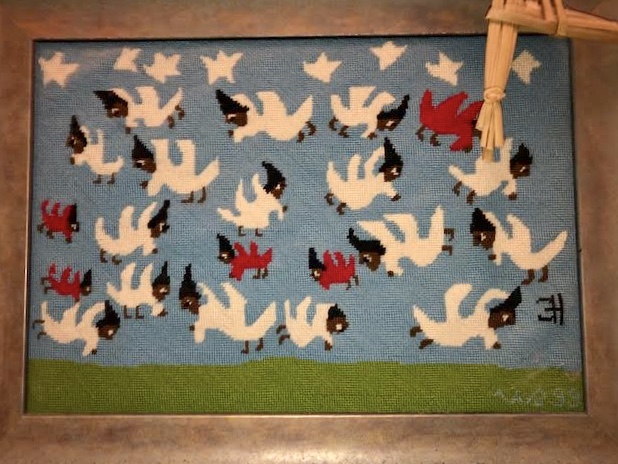
I spied several needlepoint kits that I thought were fabulous, they are reproductions of work by Clementine Hunter.  Hunter was born in Louisiana, the daughter of former slaves, in 1887. Now I have loved "primitive" art for a long time...starting with Grandma Moses who is geographically close to my family's Vermont roots. Mom had a print of hers when I was a child; I think that started it.  I also love Maude Lewis.

I purchases two needlepoint kits, now mind you, this was back in the late 1980's. One is finished.
I can't remember the name of the painting, but I recall that the little angels are white and the little devils are in red! (There's a bit of St. Brigid's cross hanging in front).


Here is the one not yet done...make not mistake, I like to stitch, I just have too many projects.  I just checked the date on the first... 1999. I'd better get to work on this next one!!


There is a lot of Clementine Hunter swag around these days, I've seen some lovely pottery. I spotted some at the Mint Museum in Charlotte last fall and here at the Gibbes. I myself couldn't resist the absurdly priced tea towel...made in India...


My bookshelf also contains a book about her which I need to read...


Thursday, February 6, 2020

LARGE Continuous Strand Afghan


Finally done after two years and many challenges. I purchased a used 5 foot square loom a couple of years ago. This was completed for the friend who made my 7 foot triloom. The yarn is Lion Brand Hometown held double for a thick fabric. I don't think I would undertake a similar project without using a natural fiber.

Here it is on the loom which was on and off my dining room table for two years. Towards the end, I could only do a couple of passes at once because of all the reaching. (I don't have back issues and don't plan on acquiring any!!)


Uneven weaving, probably due to the thick fabric and too tight weaving (hard to get it loose enough on this big a project), prompted a diagonal seam when I couldn't complete weaving on all the nails which you can see in the photo below. (Thank goodness for my trusty Janome). This resulted in a diagonal fringe on the wrong side which I kind of like. This project was a learning experience. Finished afghan is 4.5 feet square. I do love the colors!


Saturday, January 18, 2020

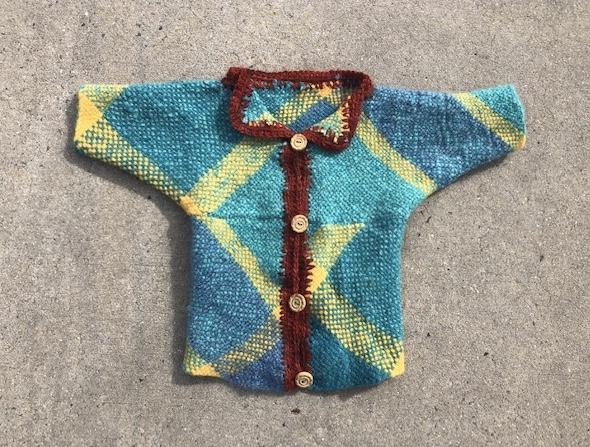
Square continuous strand loom weaving: child's jacket

I don't live where it's very cold but I love working with wool. I had purchased my 28 " square loom to do warm weather tops for myself (and I've done one), but this winter I tried something with wool yarn from my largeish stash for donation. Here are some sort of directions and photos:


I completed a square, it was woven with worsted and heavy worsted and I wove tightly so the end was a squeeze. Of course the most woven warp threads really tighten up a lot. 


 I was afraid that the weave would be too loose but it wasn't. I impulsively put it in the washer and dryer to felt it a bit. I was very happy on removal from the dryer. It would up at about a 20 inch square. Remember...you can felt more but you can't felt less...start in the washer with a short cycle and warm, not hot, water. If your fabric is not felted enough, repeat and try the dyer.

I made some strategic cuts, now that it was a bit felted it did not fall apart. At the top, opening for the neck, neck slit 1/3 of the way down, and arm hole openings 2/3 of the way down. 


Folded over thus


I sewed the front horizontal seams using a zig zag for reinforcement. I also zig zagged the other cut edges. Then, I crocheted  around the front openings and neck. Added buttonholes in my crocheting. 

Finally, I turned it inside out and made a seam to narrow the sleeves and pressed the little collar opening.  It is a US size 3-4.  Very little waste...4 triangles where I cut to fit the sleeves . (not enough to add a hood, unhappily).

Very proud of my warm little wooly jacket which will be going off to the Salaam Cultural Center for "Hats and More for War Torn Syria" pretty soon. 

Thursday, December 12, 2019

The Galway Shawl

I spent much of last weekend doing a photo album for my trip to Ireland in 2016.  I recalled being taken with woven woolen shawls that I just learned are called "Galway Shawl." These were worn all over Ireland but perhaps were called "Galway shawls" as they they were shipped to Galway for finishing and distribution...the boat journey from Paisley, Scotland to Dublin would have been shorter...

I watched "The Quiet Man" in preparation for this trip. I was pretty appalled at John Wayne's character's treatment of Maureen O'Hara's character, but that notwithstanding, I did notice the shawl that O'Hara was wearing throughout the film


 I know that the filmmakers worked to clothe the actors with locally sourced garments for authenticity. While the shawls were worn all over Ireland (and long before the movie), many of the costumes for The Quiet Man were sourced in Galway. O'Hara kept her shawl in her home after filming the movie. 

According to wikipedia, these shawls were heavy weight garments for cold weather and became popular in the late 19th century and, according to this article, were worn until the 1950's.  I think that it's important to remember that for many cultures, a warm wool shawl was the only existing "outerwear" for working class women in northern climates for generations!

These shawls were produced on hand jacquard looms in Paisley, Scotland, with a cotton warp and a botany wool weft.  (Yes, Paisley, Scotland is where they wove paisley wool shawls but that's another story!) Botany wool is merino and may at the time have been sourced from Australia. Wikipedia says that they were sometimes called "velvet" or "fur" shawls because they had a soft nap. Some shawls were shipped from the Paisley Mills to the Galway Woolen Mills where fringe was finished.  They look to be square in shape and worn folded over. The colors appear to be mostly natural wool color which makes sense given the time period and the fact that dying, whether natural or chemical (available in the late 1800's) added to labor and cost.

While at the National Museum of Ireland-Country Life in Castlebar I saw some samples, through the glass of course...


Where would our material history be if it weren't for museums like this?

Wikimedia Commons provides some available old photos of these garments 


Below is a wonderful photo from the Galway City Museum that contrasts class differences in outerwear for women in the 19th or early 20th century.   During my Ireland trip I reread Frank McCourt's Angela's Ashes.  In the book McCourt recounts that no matter how poor they were, his mother Angela always wore a coat rather than a shawl as it signified working class poverty. I find the look in this photo on the wealthier woman's face to be quite telling.


The incredibly difficult life of working class women has been romanticized in the old Irish ballad "Galway Shawl."  Here's a version by Philip Noone


Saturday, October 26, 2019

Colombian Spindle Whorls

In 2017 I went to Bogata Colombia to visit friends. A trip to the Museo del Oro, the Museum of Gold, revealed many treasures. Artists have been working in gold in Colombia for 2500 years. 


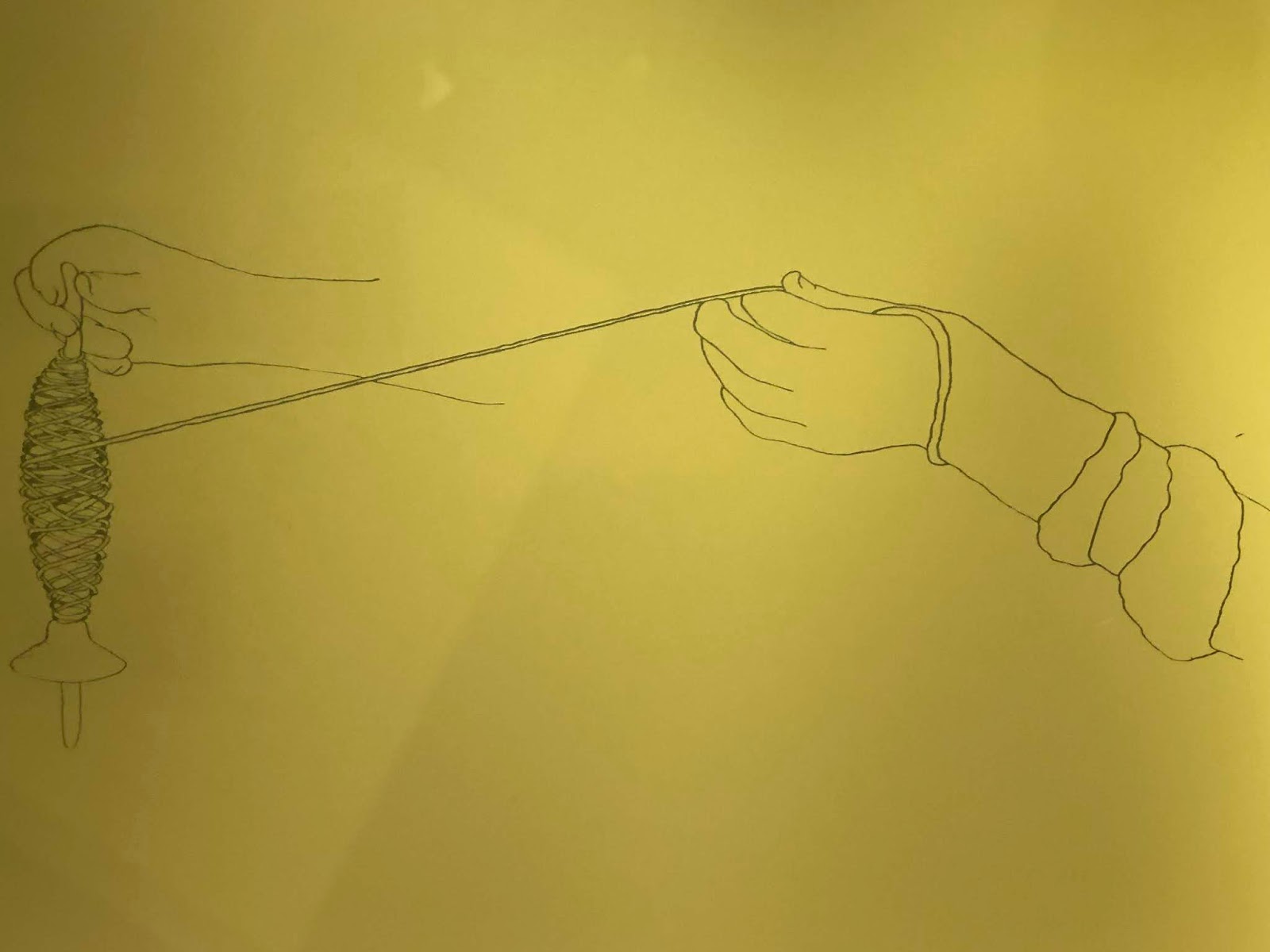
Equally as enchanting to me were the ancients spindle whorls, alas not gold.  One of the explanations hinted that the whorls were cast using a lost wax technique, but they look like engraved ceramic to me. If you know, please get in touch!  The display noted that both sisal (from the agave) and cotton were spun and used to make fabrics and functional objects, although I learned that fique, which is similar to sisal, was and still is cultivated to spin a strong fiber twine.