Showing posts with label lace shawl. Show all posts

Monday, August 21, 2023

A Local Shawl

Here's a shawl of which I'm quite proud. The yarn came from a Cormo sheep at Pat Cook's farm, Four Arches. She has a lovely  B and B and I would recommend it if you want a stay in beautiful rural Pembroke Georgia! Pat's flock of sheep and others is kind of a rescue operation, making it even more special!

The yarn was dyed with two different dyes and one pigment. The dyes were madder for the pink color, and osage orange for the mustard shade. Indigo is not a dye, it is a pigment because is in insoluble in water and forms a physical and not a chemical bond with what is dyed.

The pattern I used is Muirburn by Anne Hansen, a variation on a Scottish hap shawl.  I have been a fan of Anne's lace patterns for a long time. 


Thursday, September 23, 2021

Free Shawl Pattern: Flyde

                                            Flyde Shawl 

by Wendy Avery


I love the beautiful tones of multicolored hand dyed yarn but don't always know how to put them to best use. It occurred to me that I could use one multicolored yarn and one more tonal yarn in combination. This easy to knit crescent shaped shawl uses basic knit and purl stitches but also optional dropped yarn over stitches to create a lacey effect. The pattern helps to avoid pooling of colors and highlights the multicolored merino. The yarn creates a floaty fabric; "flyde" is Danish for "float."

Materials:

Large circular knitting needle size 2 or 3; sample was knitted with size 2. 

Yarn: Handmaiden's Halo Bundle has a skein of Angel Hair (kid mohair and silk) and a skein of Merino Slim (merino) which have been dyed together. I used Angel Hair and Merino Slim from two different Halo Bundles. The orange Angel Hair is more tonal; the Merino Slim is more multicolored featuring orange, purple, and yellow.  You could use a single bundle as well, or experiment with a fingering weight single and a silk mohair yarn, or any other 2 yarns.  Experiment!

Directions: gauge is not important. I got about 5 stitches per inch, unblocked. 

Note: rows 2 and 3 are always done with multicolored yarn; rows 3 and 4 with tonal yarn.

Cast on 10 stitches with multicolored yarn.

Row 1.   Knit

Row 2. K1, yo, k1, yo, knit to 2 stitches before end, yo, k1, yo, k1.

Row 3. Knit. Switch yarn.

Row 4. Same as Row 2. 

Row 5. Purl

Repeat rows 2 through 5.


After a while, I got bored and decided to add some yarn overs which I did in row 5 with the orange tonal yarn. If you do this, be sure to drop them in the subsequent row 2. Do them between the beginning and ending  "
K1, yo, k1, yo" sequence. I did some with 2 yarn overs then some with 3 yarn overs.  In the photo below, the first 3 orange stockinette rows are the basic pattern as written, the 4th row has 2 yarn overs, and the 5th and 6th rows have 3 yarn overs. 


Continue until the yarn runs out, then bind off loosely.

Enjoy!


Use this pattern as you wish, but please credit me and don't claim it as your design. 


Monday, April 20, 2020

FO: Cathedral Grove Shawl

I have a good friend who loves the KAL. We had two shawl KALs between us over the last year. Perhaps I will finish the first this year. The second however is done.  It is Romi Hill's Cathedral Grove.  I do love a good lace knit. It does feel like my happiest knitting place (if not the most functional sort of project...that leads me to not thinking about how many lace shawls I have finished...). The dark yarn is Malabrigo Sock, color Pocion. The wonderful rosey orange,  I have not clue. I had just enough to finish.


OK, that's it for now...I am not working at present and should have time to knit  but the garden keeps me busy, and I am determined to be a better iris gardener this year. Here is my first open of the year:  Iris Siberica, Caesar's Brother


Saturday, October 12, 2013

Not Quite a Baby Gift


So a few years ago (18 to be exact) I worked with a friend, we'll call her A.  She and I became pregnant at about the same time.

Several months into my pregnancy we moved away and I was busy being pregnant, starting a new job, etc etc.  

Now I usually knit baby gifts for friends but I was so busy that A's baby did not receive a hand knit.

Fast forward 19 years:  A somewhat newer friend, J,  (who also happens to be a knitter) is into Dr. Who.  In trolling about on knitty.com, I discovered Bigger On The Inside. No, this is not an unseemly name (and heaven knows what unseemly traffic I'll get just for typing those words) but more importantly:  it is a shawl/scarf and its name refers to Dr. Who's conveyance called "The Tardis" which was/is/will be ( think that might be some Dr. Who humor)  a blue English police box on the outside  but a larger space ship interior a la 1960 on the inside. 


(Here's the closest thing I could find during my trip to Wales...a telephone box).


So, I posted the knitty page on FB to show J.

Well, A. spied my post and immediately asked me to knit one for her daughter (who is a month younger than my son). Naturally, I obliged.  As it turns out, A's daughter is a lover of green, as am I. 

I used Knitpicks Stroll in the color Peapod.


My favorite Dr. Who is Tom Baker.  TARDIS, as it turn out, stands for "Time And Relative Dimension In Space".  

Tuesday, May 21, 2013

Koigu PPPM Addiction

It's easier to come up with a great descriptive name for a yarn with a three word title for its addictive properties, e.g. "crack silk haze."  I'm trying to come up with one for koigu KPPPM...let me know if you have any suggestions.

So here's another:  the Oyster Bay Shawl by Lori Law.


For this type of lace I like a pattern with some regular knit 2 togethers/kps's and yarn overs to create kind of a scallop-y look.


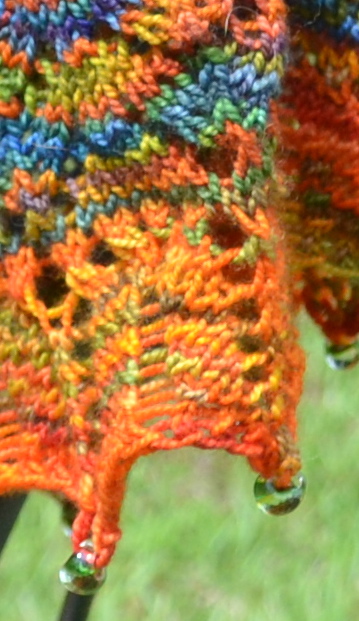
Two shades of KPPPM.  And some little pyrex teardrop shaped beads for the border from my LBS (local bead store), High Tide Beads.


Prior to the edge I did a row of eyelets with just k2tog and yo, and then I came up with my own edge as the repeat had an even number of stitches, *yo, k1, yo, k2, skp, k2tog, k2* and purl wrong side rows...there was a visible strand between the skp and the k2tog which I liked.


Isn't orange grand?


(Not sure what this is, it was supposed to be an autumn bloomer, didn't do much, lived through the warm winter and now it's got it's energy.  This is only one stalk of this large plant.)

Friday, January 11, 2013

FO: Forest Canopy

I wouldn't have chosen this pattern ...but I was in a shop  in Massachusetts in October and the woman behind the counter was really enthusiastic about it.  It's Forest Canopy.  


Easily learned repeats and not too complex for the multiplicity of  colors in a koigu skein.  I gave my Garden of Alla to my friend Susan (a trade for beaded jewelry


...so worth it) so it was time to do another.  It's a small shawl but I love it.  (I'll need to do another in the colors closer to Susan's with more oranges. 


Yes, I am a koigu addict.  Yes, there are some cheap shiny beads on the points.  And, yes, it looks great with Susan's jewelry!

Sunday, July 22, 2012

FO: Garden of Alla Shawl

I will have to eat my words from the last post about variegated yarn, now.  I loved this pattern the moment I saw it...Garden of Alla by Suzy Crancer. I had no hesitation about the variegated KPPPM in 3 different shades (or sets of shades).


 (The only thing I've done in KPPPM before was socks that were extremely beautiful but developed holes).  Little glass beads on the points.  I have lots of odds and ends of this yarn and am contemplating doing a circular shawl.  I don't usually mix lace with color but boy this does work...

Now, here's a project to help one feel a little god-like (or goddess-like):


Either that or a puppeteer who's not quite got it right...


Tuesday, May 15, 2012

Pine Tree Shetland Shawl done

It's done and so is the preliminary pattern.  More stories about the development of my first shawl design here.

Two extremely nice friends are test knitting the pattern. Let me know if you roo would like to test knit, before I set it free on Ravelry!


Thursday, April 19, 2012

Time

A good friend of mine once said "I either don't have enough time or enough money...".  I think of her quote weekly.

There are multiple UFO's right now, including...


the edge of the lace shawl that I designed.   I have trouble finding enough time to do this or any knitting...so I am doing one point every morning before work.  One point per day, I can handle it...

Working on spinning some singles lace in my favorite green that I started almost 2 years ago

I tightened and oiled my wheel 2 weeks ago so it was time to get back to it...


Saturday, February 18, 2012

Lace design...goes on and on and on OR why I love a graph

I have been busy this week.  A while back, I conceived of a shawl.  This was after my trip to Scotland and I was enchanted.  I wanted to design a shawl that was like some of those I saw on my trip.  Most traditional shawls in Scotland are square in shape, and are either 1) functional working women's shawls or 2) fancy lace shawls originally knitted for sale to wealthy women.  I wanted to design one that incorporated the earthy-crunchy feel of the working croft woman's shawl, but with some added lace patterns.  I also wanted it in a nontraditional triangle shape.

I knew in my head exactly what I wanted to do...it is designed in my head.

For the first attempt, I wrote down the directions as I knit. There are many opportunities for mistakes over the course of 300+ loooooong  rows.

For the second attempt, I started a graph. I wrote about it here. The second shawl is cute (and alpaca!) and seen here.  But my graphing skills and perhaps my problem solving skills failed in the border.  I screwed up the border and must go back and redo it...later.

This month, I returned to the graph and the shawl.  So, I being my own test knitter.  Again.


I should add that I am using excel for this graphing task.  There are some internet resources to help me, discussed here.  And, it helps to have a teenaged son at home for some basics on how to move a graph chunk from excel to a word document (use paste preview).  Working on the graph is much more fun;  this will be a graph only pattern.

I am having more success this time.  Here we are so far.  But...I'm not sure after all these hours of work that it will be free...the yarn is from Harrisville Designs New England Shetland and is lovely to work with.

Tuesday, January 17, 2012

Shetland Tea Shawl

I have at long last completed my second handspun Shetland shawl.


I described the beginning of this project here.

As I mentioned, I searched for patterns that incorporated traditional Shetland lace motifs. I settled on the Shetland Tea Shawl by Dale Long, in A Gathering of Lace.

Now, to be frank, I'm not a huge fan of XRX Press and here's why  (I hope they are reading):  They produce some lovely books, but 1)I'm not a fan of oversized knitting books, hard to use  2) Too much "beauty" photography and not enough functional knitting photography.  I don't need to look at a huge lavish garden spread with a young model sporting a garment in a way that a young-ish person would never would.  And I couldn't see exactly what the center of this circular shawl looked like!


NEVERTHELESS I was really taken with the Shetland Tea Shawl.  I loved the circular construction which I had not done before.  EZ's classic circular shaping allowed me to use the different colors that I got from the yarn in concentric circles which made sense to me.  I did not do the border that is knitted on sideways as I knew that I was running out of yarn, went instead to the old standby Evelyn A. Clark border


  O                   O 7

  O


O 5

  O


O 3

  O             O 1


 It's upside down to the border shown below.

(Maybe one of these years I'll figure out how to use Excell to do this, or breakdown and buy the right stuff to develop and reproduce charts!)


It's really kind of a chunky throw but I really love it!


Sunday, August 21, 2011

Shetland Pi

So...finding another use for more of the Shetland Supreme I purchased while in Shetland...

I dyed a whole lot of natural white plus the other natural colors with some acid dye, can't recall.  Of course, in one of my favorite colors, orange and its tones.  I put too much in the dyepot.  This was at least a year and a half ago.  It dyed unevenly and I was unhappy with the result. 


Then some months ago I realized that I could separate the shades


(the spun up stuff is on the left)

and spin them separately.  I produced a two ply in more or less 14 tpi.

Of course, being myself, I wanted to use this Shetland yarn for something Shetland-ish.  Now while a circular shawl isn't, I don't think, a traditional Shetland THING, it still incorporates traditional Shetland lace patterns. 

 Last week, I was trolling about and thinking about pi shawls.  Realized that I had A Gathering of Lace on the shelf I found this


 It's Dale Long's Shetland Tea Shawl.

Here we are, so far.  It's a heavier weight than the original but I love it.  I will knit till I run out, putting the darker colors at the border.  Another reason to love a pi.  I also love the way the natural color changes are in the circle...my yarn is lovely and springy...maybe I am a spinner, after all...


Now that I've started, I may be hooked on the  pi shawl thing.  I may have to resign from the triangle lover's club (that is, the shawl triangle lover's club).

Tuesday, August 16, 2011

FO: Half Hap in Alpaca

Oh good, a Finished Object.  I do not like how the edge came out, it's kinda like the pine tree lace opened up more than the Old Shale...I'll need to work on this for the next version...but it's lovely and soft


Saturday, August 6, 2011

Why is this so difficult?

I used to think that plants should be free, I liked to (and still do sometimes) thin them and give them away.  I think I feel the same about some knitting patterns. 

If there is nothing original about a pattern (such as a lace shawl with an old or commonly found pattern), why charge money for it?

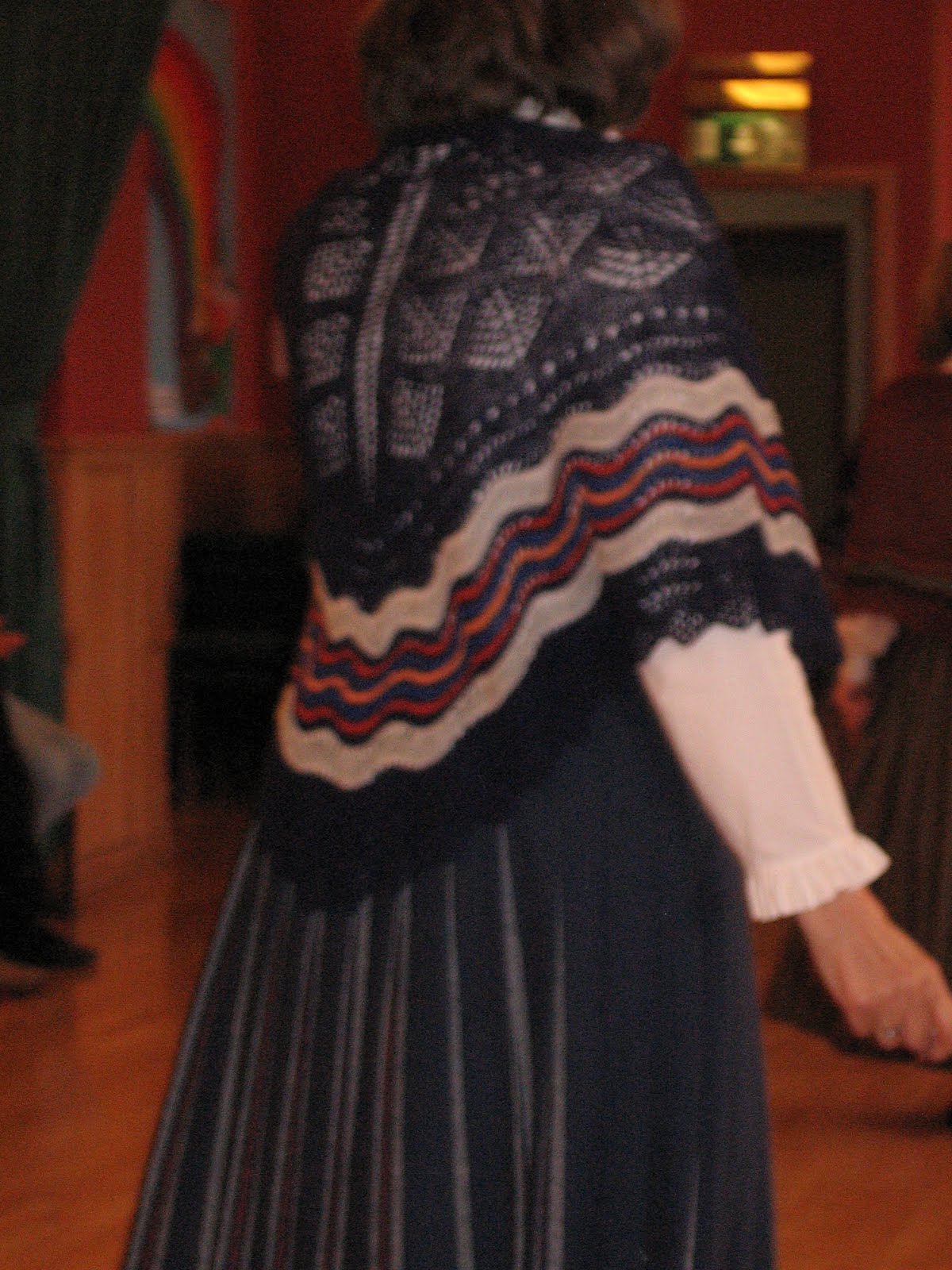
After I went to Scotland, I decided that I'd like to put together traditional patterns in a way that I had seen at an evening of country dancing.  The women wore skirts with vertical stripes, and triangular shawls to coordinate.  I've done an amount of book and internet research, and this doesn't look like a traditional Scottish hap shawl, as they were square.   They do look like hap shawls only done in a triangle, a "half hap" Joyce called it.

Even in Shetland on a cool summer evening, dancing is a hot business, so one can understand why they were wearing a "half hap."  They were done in various lace patterns, often with an Old Shale border, sometimes with the border in different colors.   But I couldn't find  any patterns to knit with this feature.   Decided to design one myself.

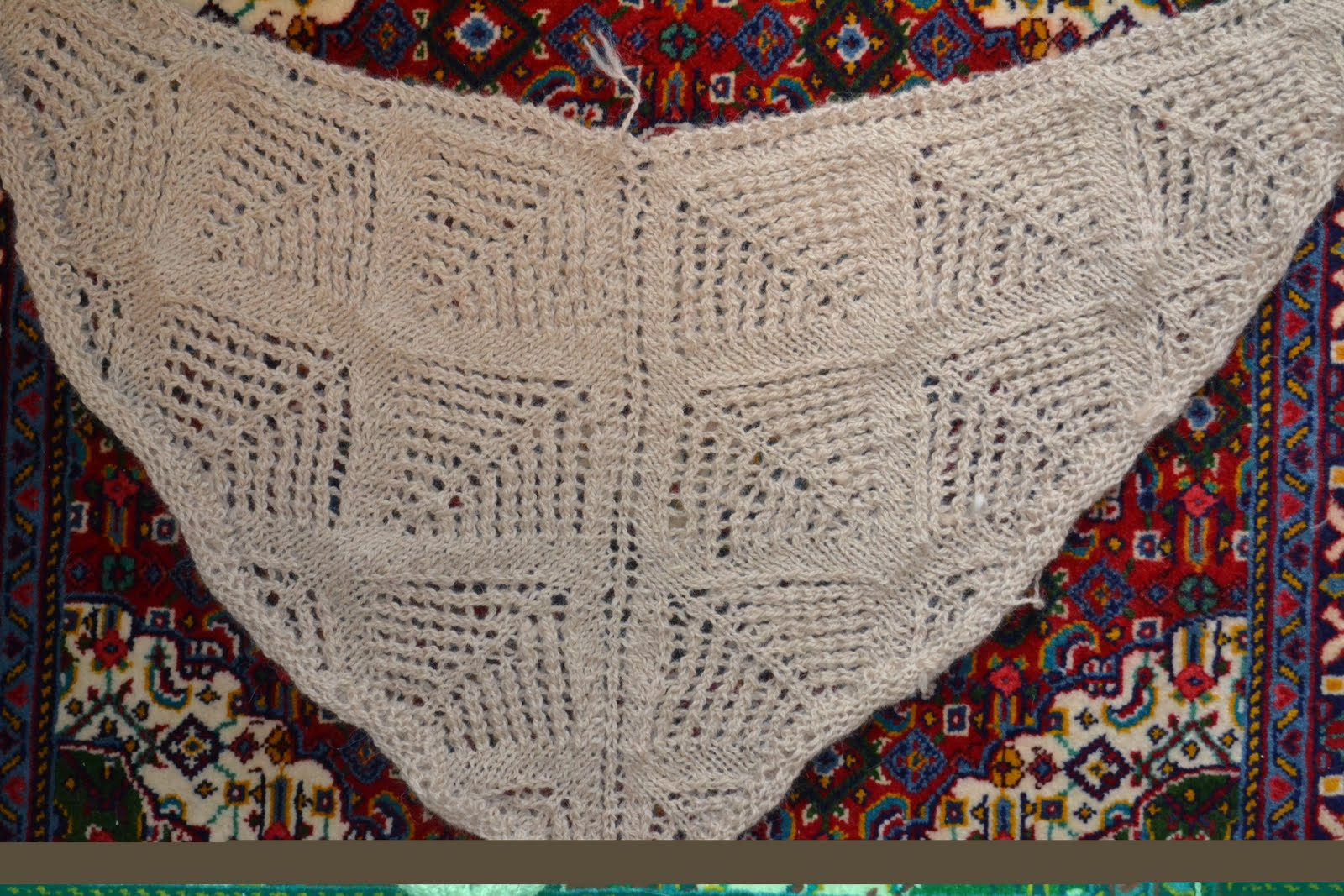
I decided that I liked the pine tree pattern with the old shale border. I knit one, and wrote out the directions as I knit.  Here it is, unblocked


But in this day and age, one needs charts.  Once I preferred knitting lace from text, now forget that. I looked around and priced computer resources for developing knitting charts, but didn't want to spend the bucks.  Then I found some very useful internet resources on how to use Microsoft Excel to chart lace.  Now, I've not used Excel except on one ill fated evening to try to plot out my monthly budget.  That effort was quickly abandoned.  This use of Excel looked to be much more fun.

Here are the sites I have used, many many thanks to the bloggers who have written up and shared their knowledge.


I set to work this June.  Oh heavens, hours, hours, hours.  It's addictive.  Like when you've lost something and can't stop looking for it. 


As a new designer, I've learning that graphing helps you to read the lace better, yet it can be confusing especially for triangles where new stitches come in at either side, and when matching up lace design elements correctly is critical.  One wants what one is sharing if not selling to be correct.  I've had to pull out the old shale several times to get both the knitting and the graph correct.  And believe me, this is pretty easy lace.

Here it is pulled out last week


So, should patterns be free?  Especially when using traditional design elements?  I have decided perhaps not, especially when spending a thousand hours coming up with the graph.  Now mind you, this has been a learning curve and I am definately still working on it.  Another test version planned, with more colors.

Nevertheless, yes, it will be available for free, when done.  

here are some photos of the ones I saw;  if you see your back or knitting design here on my blog and object, email me and I'll remove the photo...but they are lovely and I want to share...


Sharon Miller in her book Shetland Hap Shawls notes the traditional border colors.


Sunday, July 24, 2011

Old Shale

I hope my readership isn't getting tired of reading about Scotland, because I'm not tired of writing about it... When in Orkney, I bought, as I have mentioned prior, hand dyed bumps, in both North Ronaldsay and Shetland wool, dyed by Pam Murray.  I spun up the North Ronaldsay in what I could create as a laceweight, with I hope not too short runs of color. 


Pooling of color in knitting variegated yarns is an interesting phenomenon that  I don't  understand it, and I don't really like it, so it's just a chance I take in case it does...


I am not big on combining a variegated color yarn with a complex lace pattern.  I chose to do Evelyn A. Clark's Old Shale Lace Shawl.  It's a garter shawl with old shale lace at the bottom, probably with origins as a working woman's shawl.  It's not a shawl that I would  buy yarn to knit, rather, it speaks to me as what this yarn that I've created needs. It also seems appropriate to the Scottish origin of my fiber. (Plus, I'm trying to graph a shawl that I designed, which incorporates old shale, and this project is helping me on my learning curve to understand how to manipulate and chart the old shale lace.)

Old shale is an interesting lace pattern.  It involves the right leaning knit 2 together (K2) with the left leaning slip slip knit (SSK).  Here's a graph snippet


o o o o o o \ \ \ / / /


E.g., from right to left K 2 tog 3 times, SSK 3 times, yo, k1 yo 3 times.  One could do more k2 tog/ssk/yo's to make wider border repeats.


For most of my life, I've been a slob, and anytime I needed to knit two stitches together, I knit 2 together thru the back loops (K2 tog TBL), just because it's easy and fast.  I am trying to rehabilitate myself from this sloppy habit, pay attention, and take a little more time.  With old shale, this is important to get the stitches leaning the correct way in to the yarn overs.

I often lose or gain stitches with this lace and I don't often frog back to fix it (yeah sloppy here too, but I can get lost in the frogging), but if I get lost, I look for the center stitch in the yarn over section, shown here with the top yellow headed pin, to reorient myself:


This center stitch goes straight up which makes it easy to find.

Evelyn says that this is a good beginner lace pattern;  I'm not so sure.  A novice knitter friend of mine tried it and gave up.  I find it can be difficult.

FYI, Liz Lovick does a very nice job of explicating old shale versus fan and feather at her blog, here.  Liz says that "old shale" is really "old shell" but acquired the name "shale" as that's how Shetlander's pronounce it.  So now you can pronounce "shell" like a Shetlander.  And you can add "peerie" with a rolled "r" and say "little shell"  "peerie shale"!  (OK, OK it's an in-joke).