Showing posts with label Antique spinning wheels. Show all posts

Saturday, April 10, 2021

Rocky Mountain House Museum, Alberta

Not too many years ago, I had the chance to visit a friend in Alberta. We  stopped in Rocky Mountain House, I think on the way back from Olds College Fibre week. There's nothing that I like more than an old museum in a town, devoted to saving items from a town's and an area's history.   I look pretty excited on entering...


Rocky Mountain House started as a settlement, dating to the 18th century, as British and Canadian fur traders acquired furs from the First Nations peoples. Rocky Mountain House and Acton House functioned as fur trade posts from 1799 until 1876. Rocky Mountain House was owned by the North West Company; Acton House was established  the Hudson Bay Company.  The two companies merged in 1821. First nations peoples who traded included the Blackfeet, Piegans, and the Kootenays. I learned that pelts were transported east on the rivers. The Canadian reality show "Quest for the Bay" gave me an idea about the  difficulties in  transporting furs to the Hudson Bay in York boats.

Rocky Mountain House became a town after the trading post closed. Scandinavians were primary settlers to the area.   The museum contained wonderful items from the 200 plus years of the town's existence. The museum has a HUGE collection.


This is an old Scandinavian style spinning wheel, possibly Norwegian.


Drum Carder for sheep's wool.


This is an "Indian Head" for a spinning; these were usually attached to treadle sewing machine bases or a simple spinning wheel and were typically used to spin the thick wool yarns used in "Salish" and Cowichan" sweaters.  "Salish" and "Cowichan" refer to indigenous first peoples groups of the Pacific Northwest.  Here's an interesting article with more on this topic.


Oh my...


An old castle-style wheel


A double drive wheel, I'm guessing possibly Norwegian due to the slant...


Hudson Bay blankets were often made into coats. If it had a hood it would called a "capote." More information here. This may be new-ish.


Friday, February 17, 2017

My 19th Century Double Drive Spinning Wheel

I was very lucky to have a friend named Ruth  from Fiber Guild of the Savannahs help me to "rehab' my old wheel, while at the Oatland Island Harvest Festival outside Savannah last year.


Ruth taught me a whole lot and I thank her!

She believes that it is a "Pennsylvania" style wheel, and dated it to 1860 to 1890. The man I bought it from three years ago said that he and his wife bought it  at an antique store in New Hampshire in the 1960's, they were antique collectors.  I'm sure he told me that she was not a spinner. It has a treadle sewing machine band on it which broke easily so someone at some point tried to get her going.  (It was stapled together). We removed the band, which was old enough that it could be broken by hand.


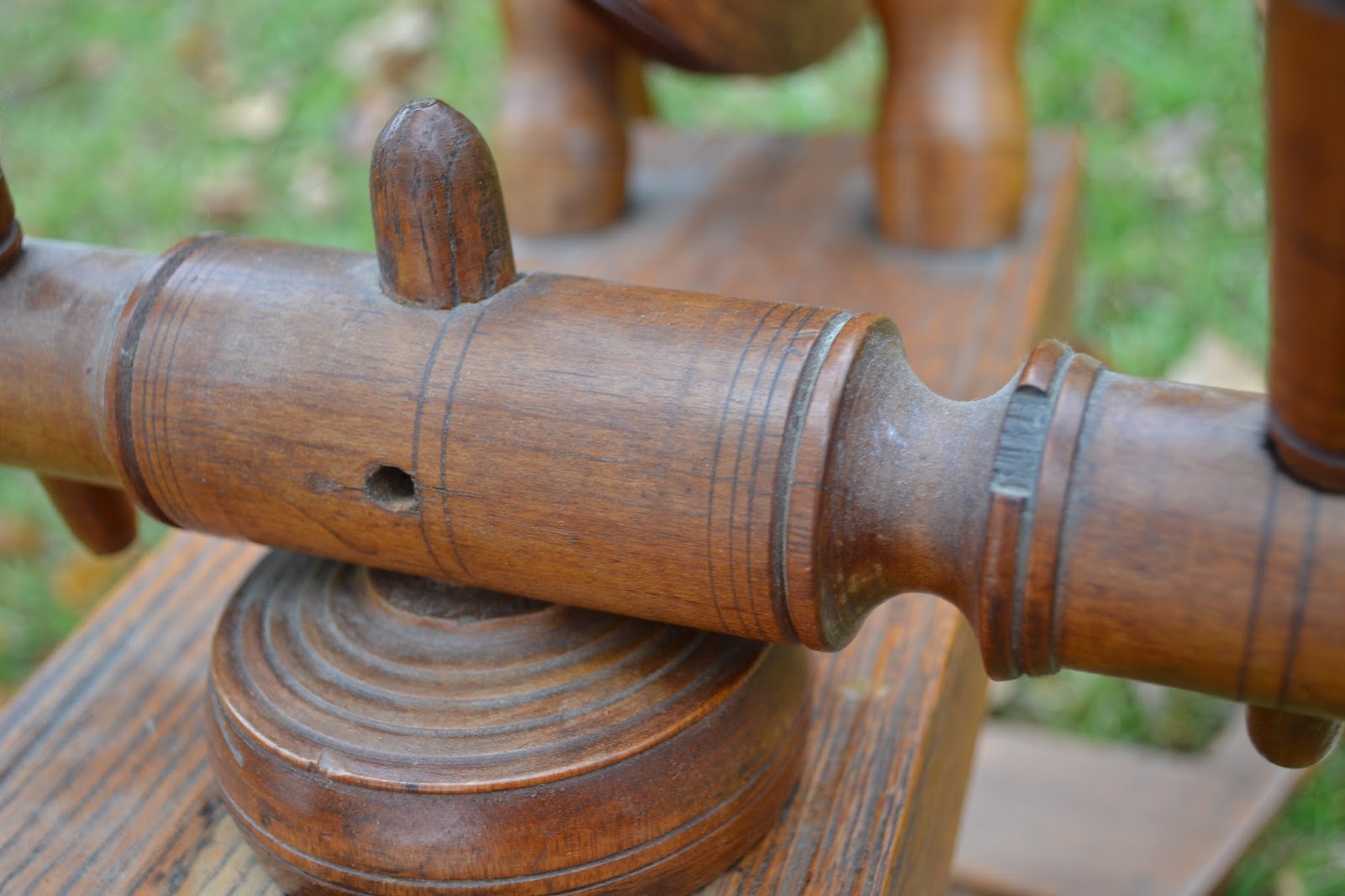
We had to clean the spindle and get some gunk off.  There was also some old wool separating the bobbin from the flyer (what's pictured is actually the drive band, below is the wool which Ruth thought looked like Shetland) , and we got them moving freely.


She told me that often women would use chicken fat to oil their wheels and then little animals would chew on the wood or leather parts. Mine has some teeth marks (hard to see) around this old repair. The string from the repair would have absorbed the lubricating oil or fat and darkened the wood in this area


She thinks that the footman and the treadle are newer than the rest of the wheel especially as the footman has a more contemporary type of manufacture.  The tie up  between the footman and the treadle is loose and I will need to retie it


Ruth was very taken with the detail that the maker did to adorn this wheel which we think is mostly oak


If I get it running well enough, she will need some new bobbins