Sunday, September 21, 2014

Denmark Part 3 Aarhus and the Gotland sheep of Lindholm Høye

 An interesting part of our trip prep was that I had two make online two reservations in Danish of course with the help of googletranslate. The first was for the ferry between Odden (in Sjaelland) and Aarhus (in Jutland). I was rather proud of myself that I made the reservation and the early morning ferry ride went of without a hitch.  


The ferry was very comfortable despite the fact that we were not in business class, clearly for some folks this was a daily commute to Aarhus which is a large university town.


The ferry port is in practically in the city, so it was a short drive  to the museum, ARoS Aarhus Kunstmuseum. The museum is 10 stories tall. Teenaged boys were fascinated with the rainbow walkway at the top, and indeed a lot of the whole museum.  Quite amazing. 


[Side  note:  it's unpredictable what museums or museum exhibits MY young men enjoy.  They do not like looking at paintings. ARoS got it  right, they both enjoyed photographic exhibit and the walkway.  At the Smithsonian last year one like the Chinese pottery as he also like to throw pots…the other liked the sculpture. So I guess my advice is…keep taking your bored teenagers to museums because something will catch their fancy.]   


Seen at the museum


Myself, my wonder is of the nineteenth century painters.

This is a detail of a painting, I will find out the artist and update


Here is a smaller detail, she is making a fishing net with a tool  the same as the one I purchased in Iceland several years ago


I set it on a Peruvian textile to photograph it, looks a bit like her skirt!


The  painting below is by Edvard Peterson from 1890, "Emigrants at Larsens Plads."  Peterson was a social realist painter who painted the realities of everyday life of working people. (I now have a new favorite genre of painting).  This painting is very meaningful to me as my Great Great Grandparents emigrated to New York from Denmark in 1860 with their first baby.  The baby, Christian, did not survive the ocean voyage. The strife and anxiety and necessity of a pending emigration depicted in this picture are very poignant to me.


Here's a nice site with more information on Aarhus

Mom wanted to drive from Aarhus to the Moesgard Museum nearby in Holbjerg and was dismayed to learn that it was under renovation. She REALLY wanted to see the Graubelle Man, one of three ancient people who have been discovered in Jutland's peat. Unhappily for us but great for the Moesgard Museum, it is under renovation and closed this summer.

So we settled on a visit to Lindholm Høye, a Viking burial ground.
Here's a  site with more detailed information.

It was in an idyllic setting with sheep grazing around the monument stones.  It was ever thus!  The sheep are Gotland which are apparently raised throughout Denmark. More on this in an upcoming post.


The shop was nice, plenty of Viking garb


There was a lovely cafe and store, purchased some natural dyed yarn


Natural dyes left to right: Dried Tansy, St John's Wort, madder and a darker madder.


Sunday, September 7, 2014

Spinsjal Organic Scarf (Free Pattern!)

I do very little pattern writing but here's a little thing that I came up with. It uses my handspun and hand dyed silk. I will also put up a link in the "Free Patterns" section.  Try it and let me know how it turns out!

Organic Scarf
from
Spinsjal Designs


This is a “recipe” pattern for a garter stitch scarf that can be as wide and as long as you like.  The sample uses handspun silk that was hand dyed with eucalyptus. 

Materials

Yarn: I used 100 yards of handspun silk which was 11 wpi (wraps per inch) and a bit “thick and thin.” My gauge was 4 stitches per inch. You can use whatever yarn at whatever gauge you like, but be mindful of drape and softness.

Needles: Pick some needles and knit a sample that creates a nice “fabric” for your scarf, adjusting needle size as needed. I used size 4 straight needles.

Dyeing: My yarn was dyed with eucalyptus. Silk takes dyes well and has a lovely tone to it. If you would like to dye your own, see the general instructions in this post at my blog: http://spinsjal.blogspot.com/2014/03/eucalyptus-dyepot.html.  Some prior experience with natural dyeing is recommended before you use a precious yarn as dyeing is always an experiment, and results can vary. I did NOT mordant this yarn, so I expect that the color of this scarf will fade with time.

Knitting

Cast on 30 stitches. Knit 10 rows or 5 garter ribs. Next row: k 2 tog in each stitch. 15 stitches remain.

Knit to the length that you would like your scarf, minus the ruffle border.  

I had a limited amount of yarn and wanted to use it all. I calculated how much I would need for the last 10 rows of the scarf (the ruffle end) in this way: I needed 5 times the length of a row of knitting to actually knit the row.  I measured out enough for the last 10 rows by measuring out the yarn based on the width of the beginning ruffle. 

When you are ready to knit the end ruffle, do an invisible increase in each stitch in this way: pick up the stitch below your stitch and place it on the needle. Then, knit each stitch. Here’s a good website for pictures of this technique: http://techknitting.blogspot.com/2007/05/very-nearly-invisible-increase.html.
At the end of the row you will have 30 stitches. Continue knitting in garter stitch for 10 more rows then bind off loosely.


Sunday, August 31, 2014

Knud Rasmussen and his Famous Sweater

Some years ago, I become interested in exploration of the Arctic and Greenland. In my casual reading on the subject I learned about Knud Rasmussen (1979-1933).  (If you know that this name is in my family's past…no, he's not a relative!)

Rasmussen was born in Ilulissat Greenland to a Danish father and an Inuit-Danish mother. His father was a missionary. (OF COURSE we all know that at present, Greenland is an autonomous country within the kingdom of Denmark).   Rasmussen learned  Kalaallisut or  the Greenlandic language as a child. He was educated in Denmark. He became a polar explorer and anthropologist after a failed attempt at being an opera singer of all things.  Here is a favorite photo of mine of Knud, wearing a hand knit "Icelander" sweater.  


Ironically and synchronistically, an article came out on polar explorers and their sweaters in the latest issue (July-August 2014) of Piecework magazine. The article was written by Lita Rosing-Schow, who is Danish. The sweater is called an "Icelander," a type of sweater knitted in the Faroe Islands (also part of Denmark, remember? And while we're at it, Iceland was part of Denmark till 1944 as well!) for export. Schow suggests that while these sweaters were and are still available in Denmark, that they may have been purchased in Faroe, where explorers would stop to purchase sled dogs as well.  The two color pattern is of course warmer due to double stranding of the yarn, and these patterns while "traditional" to Faroe, are ubiquitous to this part of the world. 

Later in the trip I came upon this painting while visiting an artist's home in Skagen


The subject resembles Tom Baker more than Knud Rasmussen but he's definitely wearing that Icelander sweater.  I could not identify the artist or the subject.

I myself knit a sweater that could qualify as one. These sweaters would have been summer wear for explorers but mine was too hot for South Carolina even in the winter and it is now a nice pillow on my sofa!


So naturally while we were trip planning, Mom found that Rasmussen's house was now a museum and we included a stop on our trip. His home is in Hundested, there is no website that I can find.


It was a lovely isolated location where Rasmussen worked in between trips. He was a prodigious writer, documenting his trips well.


More on Rasmussen, if you're interested:

In 1910 he and Peter Freuchen established a trading post in Cape York named "Thule Trading Station", on Greenland's west coast. The west coast of Greenland is less accessible than the east as it is iced in more months of the year. A Danish website this one says that "his goal was not to conquer new ground but to meet new people."  One can tell that just from looking at his face!


Rasmussen led seven expeditions around Greenland and the Canadian arctic; the most notable of which was the Fifth Thule expedition (1921-1924), which sought to learn where exactly those "Eskimos" came from (we now know…from Asia). He and his group which included two Inuit hunters went by dogsled from Eastern Canada to Nome Alaska over the Northwest Passage;  he tried to enter Russia but his visa was denied. During this trip the trip members conducted interviews (his version of Kalaallisut was understood by those Inuit he met across the top of the American continent).


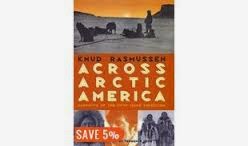
A very nice film entitled "The Journals of Knud Rasmussen" explores his journey in the Fifth Thule expedition.  If you are interested, be sure to read "Across Arctic America," available from our friends at Amazon and reprinted by our friends at University of Alaska Press. It was originally 10 volumes, more or less, but in the introduction Vilhjalmur Stephansson assures us that this single volume was personally edited by Knud himself in English.


For more information on Knud, this is a great website. Yep, it's in Danish, but that's what Google Translate is for. 

If you want more visuals on explorer's sweaters,
a recommended miniseries is "The Last Place on Earth" about Amundsen and Scott's race to the south pole. 


Sunday, August 17, 2014

Denmark part one: Weaving Viking Sails and Twisting Viking ropes in Roskilde

After arriving in Copenhagen we immediately rented a car and drove to Roskilde.  Roskilde is in Zealand (Sjaelland), about a half hour drive from Copenhagen. Roskilde is the site of The Viking Ship Museum.  

(You may have heard of Roskilde because it is also the site of the largest outdoor rock concert in Europe, held every June).

The museum houses the remains of 5 Viking ships (called all together "Skuldelev" named after the town  north of Roskilde where they were found). The Vikings would block a fjord from attack by scuttling ships in the fjord; a rather passive and effective strategy for a bellicose people. These ships were submerged between 1070 and 1090, discovered by a fisherman in the 1920's, and were excavated in 1962. Those Vikings built  different types of vessels for different purposes. More on the Skuldelev here.

To my delight, there was a small display on how the sails were woven.  Sails were woven on a warp weighted loom. (The horizontal loom was not developed until the mid 14th century i.e. [I always must look this up!] around or about 1350).


Here's a very happy tourist:


The fibers on display were hemp, nettle, and flax although wool was used in Viking square sails as well.  Here is a fascinating article on the subject complement of The International Journal of Nautical Archeology.  Or at least I found it fascinating until I got to the part about warp and weft strength that involved math equations.


A reproduction vessel with  a Viking Square sail:


You could also dress up like a Viking if you wished:


The rope making display was pretty interesting as well for someone like myself who is interested in twisting fibers


The museum contains the remains of the vessels. Viking ships were "clinker built" also called "lapstrake" in which the hulls were built of boards which overlapped.  More info here.


 The museum has a boatyard that builds reconstructions of Viking boats with the method of the time, as well as new boats using old tradition, and repairs old boats.


Later in the trip I went to the National Museum of Denmark. They of course had a wonderful exhibit on the Vikings. At the beginning of the exhibit there was commentary on the Viking discoveries, and how with the loss of Norway in 1814 and southern Jutland in 1864, the national spirit and identity were boosted by discoveries of the Vikings finds which happened in that century.  
Later that day we went to the Roskilde Cathedral; it s a cathedral of the Lutheran Church of Denmark dating to the 12th and 13th centuries. It was the first Gothic cathedral build of brick in Northern Europe. It also incorporates Romanesque features. There are numerous crypts in the cathedral which was used for burial of Danish royalty for.