Showing posts with label Mexico. Show all posts

Wednesday, September 25, 2024

Saltillo Weaving

 This year, I visited Sante Fe. While there, I spied a weaving in a consignment shop that was familiar.  My Mom had purchased several weavings years ago, with a center diamond or lozange. I had always thought that they were Navaho but they were very finely done.  In this  consignment shop, I saw a weaving very like Mom's called a "saltillo." Here's one of Mom's


The fringe is made from the warp, whereas with Navajo weavings, if fringed, it is sewn on.  The weavings of Mom's have cotton warp and wool weft.  

A bit of research revealed that this weaving style originate in Saltillo, Mexico, in the state that is now Coahuila.  I suspect that these are indeed Mexican, due to the age (when Mom purchased in the 70's so hers are at least several decades older than that) and the discoloration from age seen in the cotton headers and footers of the weaving. 

 Here are the other two that Mom purchased. I learned that sometimes the colors of the Mexican flag are included (red, green, yellow). Ironically Mom, who has better seasonal decorating tendencies than I, would put them out for Christmas due to the red and green. 


The sett  (ends per inch) on the warps is about 12 on all.  

Here's the one in Sante Fe that clued me in:  the price is $325 (not that I care, all good weaving is priceless!). The ombre effect in the one below is similar to the weavings that Mom owns.




Sunday, March 24, 2019

Huipiles I own and a free huipil pattern or two

I love huipiles...you know those  tops originally from Guatemala and  Mexico that can be elaborately embroidered.  They are created from a flat piece of cloth and thus are an easy "canvas" for creativity.

The V & A has a fabulous article on huipiles, the colonial style Mexican blouse, and rebozos.  According to this article the concept for the huipil, from Mexico and Guatemala,  has "evolved" over 2,000 years. Originally it would have been backstrap woven and would have been created from one or two wide strips of clothing.  Designs could be woven into the cloth.

This blog post, an interesting fashion read on what people of mixed race wore in 18th century Mexico, shows a woman wearing a huipil in  Frame No. 7.

I visited the Museo de  Trajes in Bogata in 2017; here is a photo of a Mexican huipil fragment that I took there, note the beautiful pickup woven inlays


Here is one that I purchased at Frida Kahlo Museum in the museum shop (Frida culture  has popularized huipiles). It is of muslin, the width is just over 24 inches, with the selvedges used so that the arm holes did not need finishing. 


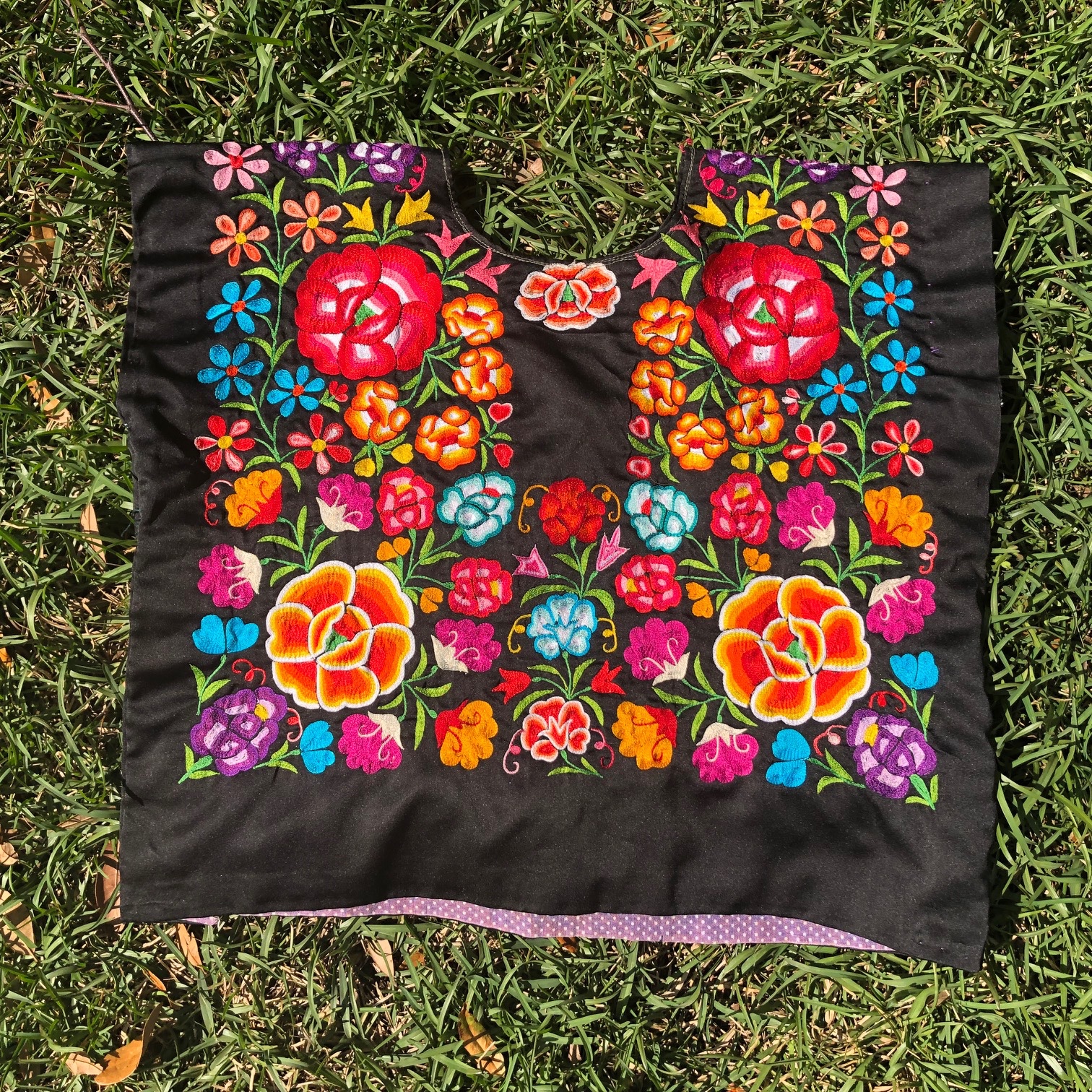
Here is one I purchased in San Miguel d' Allende, but it is a special use of the huipil execution called "tejuana." Tehuana dress originated among indigenous Zapotec women on the Isthmus of Tehuantepec, in Oaxaca.  This one  is on satin with a cotton cloth lining. The colors and handwork are exquisite with most all the work done in chain stitch.  I think all colors look better on black; it provides a wonderful contrast.  In the article from the V & A above, there is a photo of women from Tehuana dressed similarly for a religious celebration.


Here is another purchased on ebay. It is on blue velvet, again with a cotton cloth lining.


If you are interested in sewing or embroidering/creating one of your own, the Victoria and Albert Museum recently had an exhibit entitled "Frida Kahlo: Making Herself Up" which showed Frida's clothing and personal artifacts, including this


Here is Frida in a huipil in New York City, photo by Nicholas Muray, one of her lovers.


The V&A has a pattern for a huipil which is available online, with options for a round or a square neck. The pattern was developed by Alice & Co Patterns

Interestingly, as part of this year's Quilt National, there is a class in using a shirt to tell a story; the basic template is a huipil. Here is the basic pattern at this website.

And...as long as we are talking Mexico, here is a wonderful song to hum along with as you sew, featuring the fabulous Natalia Lafourcade along with Emmanuel Del Real,  a clip from a great movie,"Hecho en Mexico." Natalia has been known to adorn herself with beautiful traditional-inspired Mexican clothing.