Showing posts with label eco-printing. Show all posts

Friday, August 26, 2022

Playing with Indigo

 My friend Janet is messing with indigo in a big way, and I am going along. Here is some stuff that um...happened. I think that "indigo" is a catchall term for any plant that contains the indican molecule.  Janet has both persicaria tinctoria and indigo suffruticosa in her garden.

So, Janet put some "Japanese indigo," persicaria tinctoria,  (out of her garden) in the blender with some ice, and dunked some wool in.  Now, I should add that while I like dark "indigo" blue, I am a bigger fan of green.  

I took this (unreduced) minivat of green slush home and put some combed merino top in it. What did I get? Chlorophyll coloring I suspect, although it has a blue tinge. It is a pale minty color. I am waiting for it to fade. I love it.


Then yesterday, I went over to Janet's place which is dubbed "Camp Janet."  (Camp Janet involves a major wonderful fiber-and-dye studio). 

I decided to try some  hammering.  I've always thought that this was a great activity for children and not for me, so of course here I go... In the photo below, in the oval, is the hammered tinctoria...it did not transfer much. However, the suffruticosa hammered beautifully.  In the bottom part of the photo, you can my experiment to  dip the linen in a rust and water bath but the print came out less defined because it was wet; however the iron did not change the color (bottom of the photo).   (The dark brown red colors are flower petals.)


Here is a close up of the suffruticosa hammered print (with some fainter persicaria on the left). I'm pretty sure that this is all cholorophyll. We will see how lightfast it is and for how long...I love the green.


And then,  Janet  put up with me asking her to simmer some of the indigo suffruticosa without reduction. This allowed me to put in a roll of paper, leaves, and linen to simmer. (Yeah botanical printing of a sort which basically means MY sort). 

As you can see below there is green around the border that survived the simmer. The photo shows  linen above and watercolor paper below.  The green turned out gray-green on the paper. This print included my favorite sumac leaves, rhus copilinum. With a nasty smudge of coreopsis that turned rather bloody looking (but of course looks better on the paper...)


I used some of the hammered linen in this roll and it survived the heat and pressure (see below in the circle). 


And...in the mean time...I have learned that  cholrophyllin extract  exists as a dye...

Sunday, May 16, 2021

Botanical Printing May 2021: Osage Orange Vat

 More botanical prints...I'm trying different things to compile a list of "good printers" and combinations to see what I want to reattempt. I've switched to Fabriano sketch paper for all, using a foldover technique to capture on both paper and fabric, which for me is old unmordanted sheets.  I use a wooden dowel to roll on unless otherwise noted. These are all from one vat that probably deepened as I used it with addition of iron molecules as I went along...colors are more yellow in real life 

paper imprint on fabric for comparison


some nice images from ornamental  Japanese Maple, 2 types


here is the leaf arrangement for above:


I like the large fern leaf above and below, but it did not give off much tannin, I found it in the fall and had dried  then rehydrated it, the fern was a very dark purple when I picked it as you can see


I went to a more reliable printer, fox grapes leaves, there's a fern image as well on the paper which is mirror image of the fabric, I like a reliable printer!  I would like to handstitch this one...


  here is the leaf arrangement for above:


Next I switched to a copper pipe and dipped the fabric in half vinegar and half water. It brightened the color of the osage orange but still did not get much print, clearly it needs iron to pull it out, again mirror image on the paper. The paper always gets a different sort of print color wise 


back to iron water dip for the fabric this time wrapped on copper pipe. I like the mauve quality to these; not sure what caused it...the unidentified tree leaf?


here is the leaf arrangement for the above: below: tree leaves, unidentified, hydrangea upper right and lower left, early magnolia leaf, and lower right geranium.  


something went green on the one below, I think it was the hydrangea leaf. A dot of pink-red came onto the paper from the hopi red amaranth leaf, but not onto the fabric


this matches the right side of the above panel


Monday, May 3, 2021

Botanical Printing Fall 2020

I did an interesting zoom workshop  last autumn with Elisabeth ViguĂ© Culshaw. Here is her website, https://thelansdownehouseofstencils.com/. I can highly recommend Elisabeth's online workshops, of which there are many topics. She is a wonderful teacher, provides clear instructions and materials, and you can replay the video on zoom for a period of time for review. I can't recall the title of the class but it involved eco printing on paper.  I am interested in wild plants so collecting things was fun and easy. It was supposed to be a paper class but I wound up liking the fabric blanket results more! Also, the paper I used wasn't very good for this purpose; either too rigid or it fell apart.

Here are results with Bluffton SC water...all fabric is old white sheets with the exception of some silk scarves noted below


Iron mordant blanket, onion skin bath...these were the first I did, which then spun off lots of other attempts with stuff from my collection of dye materials


on paper


\
Iron Mordant on blanket, madder bath (photos are blankets with corresponding paper results)


Alum???  mordant on blanket, Madder Bath

blankets...


and corresponding Paper


Iron blanket with Osage Orange


Annatto bath, possibly iron mordant, I did not make a note, my bad, maybe it was alum as the print did not show well. I buy annatto seeds at the Halal market in Savannah.


Purchased eucalyptus leaves with Saxon blue dye bath.  I did not note the mordant but I'm guessing alum. I was disappointed that the leaves did not print more orange.  I like the scarves but they are a bit dull.  Interestingly, the saxon blue got green toward the end. 


Coreopsis dye  from my flowers with alum blanket, some iron in the pot.


Osage orange with iron. I had done this combination before (see above) but the result is different. Can't see many leaf prints!


I really liked the results where the plants showed up purple-y...but that was better with the iron mordant blanket. On the other hand, I prefer the madder dye color which showed up best with the alum mordant...

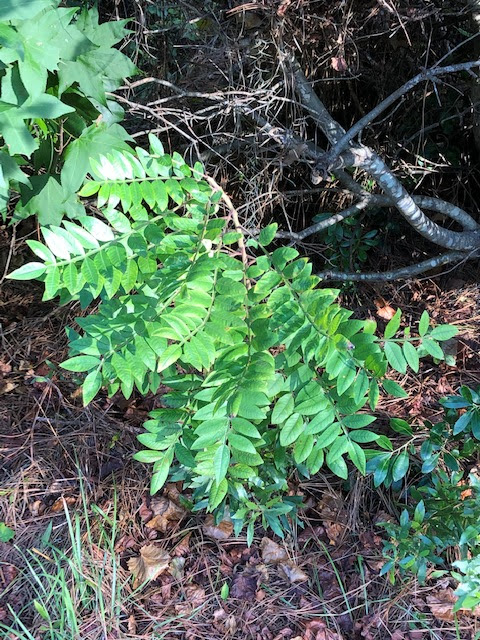
Here is my favorite plant which I just happened to pick during a morning walk, it is winged sumac, Rhus copallinum. Usually shows up purple-y with the iron blanket.


Here's another:  I am somewhat sure this is fox grapes, vitis labrusca, although I have yet to see grapes on it anywhere.  If someone knows better, please let me know!


Saturday, December 30, 2017

Indigo Dyeing with CHI Design

My fiber guild sponsored another indigo dyeing opportunity this fall. We welcomed Caroline Harper of CHI Design. Her company is "an indigo arts studio" working to bring indigo back to the Low Country as a useable, local dye. Caroline works with natural fibers and sells indigo powder. She is working to make the processes to produce powder from  the indigo plant, which she plants and harvests.

We first did an eco dyed scarf; Caroline had 3 natural dye vats for us to use after placing and tying up our natural materials


Then we proceeded to indigo, here is a cake of indigo produced by CHI designs


clamping a scarf for resist using a shibori technique


 Cochineal which has turned purply due to items already dyed in the pot


  I really liked this result


Here is my ecodyed result


And here is my indigo result, possibly one of my favorite indigo scarves that I've done


I find that no matter how many workshops I take, I always learn something new...

Here is a brief video showing Caroline doing some traditional Japanese  shibori techniques


Here is another link to a short film at her website