Showing posts with label Norway. Show all posts

Saturday, January 15, 2022

Felted Slippers

 It's January and my feet are cold. I reached for the felted slippers that I made last year.  


I really did not believe that I could felt these slippers to fit, but it worked.  What's even dumber is that (of course) I was so impulsive that I couldn't wait to felt the first one before making the 2nd one, so they were felted at different times (I don't recommend that, though; I will try to restrain myself if I do another pair).   I did short cycles in the washer with warm water to get them right. 


I knit them from this book:


It is out of print but Amazon has used copies PLUS Arne and Carlos have a pattern at their website 

https://shop.arnecarlos.com/product/basic-pattern-for-slippers-copy/

PLUS there are youtube videos.


I'm sure that if I lived in Norway I would wear these most of the year. Be sure to watch some video of theirs to see Arne knitting. So fast!

Sunday, May 17, 2015

Syttende Mai and a bit of Norwegian history

Last evening's Prairie Home Companion with Garrison Keillor talking about Syttende Mai (and singing some traditional Norwegian songs) prompted me to do some research on this holiday...and brush up on some essential Norwegian history...

Today is the 17th of May, a national holiday in Norway.  It is Nasjonaldagen (National Day) or Grunnlovsdagen (Constitution Day). In 1814 on this day Norway declared itself an independent kingdom to avoid being given to Sweden by Denmark after Denmark-Norway's defeat in the Napoleanic Wars.   (The Norwegian provinces of Iceland, Greenland and the Faroes remained with Denmark).  There was terrible poverty and mass starvation as a result of this defeat. 

 In of course the expected political ironies, Norway actually WAS given to Sweden.  but the opportunity presented itself for the country to attempt to declare a level of independence.  Norway kept its liberal constitution and institutions with exception of the foreign service. Because of the Napoleonic Wars, economic development in Norway was slow until around 1830..(making immigration to the US in the 19th century very tempting). Because of the lack of independence, there was a rise in Norwegian romantic nationalism. 

Norway's true independence  did not actually happen until June 7, 1905, when Prince Carl of Denmark was named King of Norway and called himself Haakon VII. 

Coincidentally, WWII ended 9 days before Syttende Mai in 1945, adding more meaning to independence at this time of May! (As we know, Norway was occupied by the Nazi's during WWII).   As the website for the Vesterheim Museum in Decorah Iowa suggests, it is a great day to celebrate freedom all around!

Here is an old photo taken by Paul Stang in the early 1900's of a Syttende Mai celebration in Stongfjorden


Mom and I visited Norway and a few other places  around Scandinavia in 2002 

Here's a postcard that I picked up of a little one and her castle wheel, dated 1904, the distaff suggests that she is spinning, or pretending to spin... flax


We went to the Norsk Folkemuseum, the Norwegian Museum of Cultural History at Bygdøy in Oslo, and saw dancers in traditional costumes, some of which people wore today!

The women are wearing Bunad, here's a definition from Wikipedia

"Bunad (Norwegian plural: bunader) is a Norwegian umbrella term encompassing, in its broadest sense, a range of both traditional rural clothes (mostly dating to the 19th and 18th centuries) as well as modern 20th-century folk costumes. In its narrow sense the word bunad refers only to clothes designed in the early 20th century that are loosely based on traditional costumes. The word bunad in itself is a 20th-century invention.
The bunad movement has its root in 19th-century national romanticism, which included an interest for traditional folk costumes not only in Norway, but also in neighbouring countries such as Denmark and notably Germany. However, in Norway national romanticist ideas had a more lasting impact, as seen in the use of folk inspired costumes"


Finally, we took a boat down Sognefjord, here I am at Kvikne's resort


King Harald and Queen Sonja just happened to be visiting that day, here you see Harald waving...yes...to me!  He is the Grandson of Haakon VII.


 And here I am outside of Bergen at the tomb of Edvard Grieg and his wife, I am wearing a Dale sweater purchased in Norway...


(Thanks as usual to wikipedia...yes, I send them a donation yearly!)

Monday, October 25, 2010

Another Norwegian, Stranded

Once upon a time, I just knit.  Now, I think about my materials, and have joined the sisterhood of knitters who want to make their own and know where it all comes from.  (Sorry, guys, I know you're there and I love you but we're in the majority!) Sometimes though, knowing where it comes from is as important as making my own yarn.


In reflecting back on my prior post about my lusekofte which I did in  Heilo, I thought about something I heard on the Knitpix podcast several weeks ago.  Kelly, in Episode 4,  suggested  choosing wool for a sweater's use or intended wear based on the qualities the sheep's fiber possesses.  Those qualities are  determined as a sheep variety  acclimatized genetically to that  area.

For example, Kelly points out, Norwegian sweaters are historically knit from yarn from local sheep that withstand the cold climate in the northernmost parts of the northern hemisphere.  The fleece on these sheep has long fibers, which make them durable and good for outdoor wear.  The fibers have a wavy crimp, which sheds water well.  The fibers are a little shiny.

Heilo is "pure Norwegian wool" but the label states no further indication of breed or variety of sheep that composes it. One assumes that the sheep contributing to it live or lived in Norway.  In the photo above you can see how this nice crispy yarn also lends itself to stranded colorwork (it's the red and white sock I'm working on).

Spaelsau is a breed of sheep native to Norway, but according to wikipedia, only 20% of sheep existant in Norway are spaelsau. (I cannot spell this word "spaelsau" correctly here at blogger, the a and e are supposed to be smushed together into the phoneme which is actually a whole entire letter in Norwegian).  Landrace is the term used to describe a variety of animal native to a particular area that has genetically adapted to that area, as opposed to a "breed" which has been genetically bred to attain certain characteristics. Spaelsau are considered by some to be Norway's landrace sheep.


A couple years back, Dale published a book containing updated versions of sweaters from the 1950's, book 52.  I love this collection although I've only done this one, 5210:


Kelly's podcast helped me understand about how qualities of fiber determine the type of resulting yarn, and how in turn that helps one to select breed of sheep or yarn content for a particular project.  This episode is from 2007, I'm behind! I spend alot of time in the car for work, and I am a religious knitting podcast listener.  Check out the array on itunes.

Wednesday, September 29, 2010

Kashmir and Flower Basket

Dale of Norway has  a retail line of sweaters and outerwear as well as patterns and yarns for those of us who prefer to knit our own.  The pattern lines for adults are updated with regard to style and color, but still often reflect the heritage of stranded, multicolor knitting.

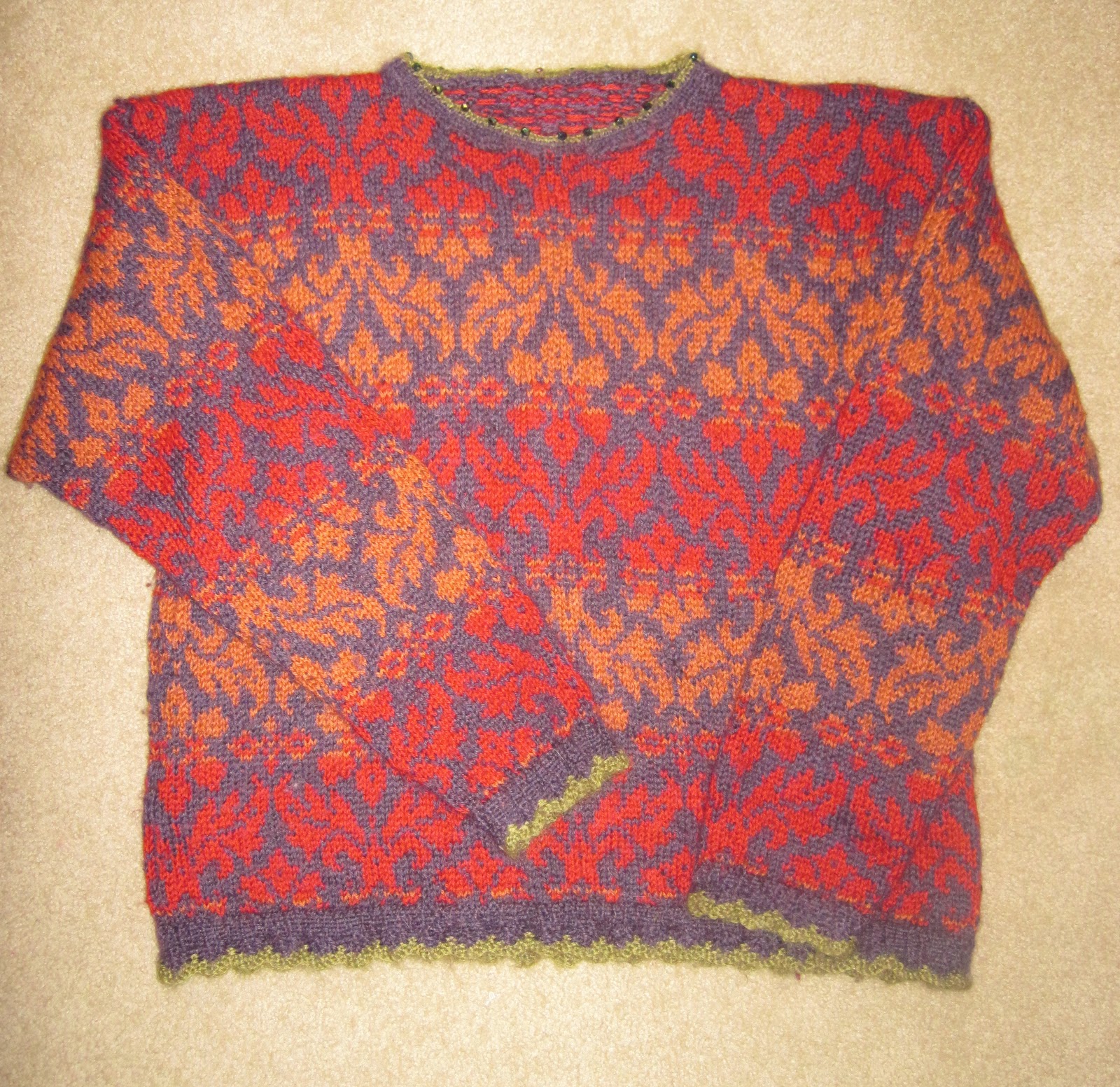
My favorite Dale sweater that I have done is Kashmir, from Tiur, 60% mohair and 40% new wool, 5 ply sport weight:


I love the original colorway clash of the purple, orange, red, with a little tipping of green on cuffs and neckline.  The pattern is Dale of Norway, book 6030.  It made a lovely fabric that is extremely warm but has some drape.  It's a little itchy next to the skin, so I usually wear a turtleneck with it.  I added some beads around the collar of the sweater. The sweater actually has a matching lace scarf also, which I have not been able to get the edges to lie flat despite several blockings.  But of course I added beads on the end of that too, which weigh it down:


The mohair gives the Tiur some shine and it looks great in this stranded pattern, which to me is  of course reminiscent of an oriental carpet, in a damask print sort of way.

I had a fair amount of Tiur left over.  So, I went on to my favorite shawl pattern at the time, what else but Flower Basket?  After confusing myself in my post on Flower Basket Shawl, I've given up on numbering them.    I added small beads at the border, and I think I ran out of yarn so the points did not come out in the blocking.

I was really pleased with how the Tiur knitted up so well for two very different types of knitting.  The halo of the yarn made it nice for colorwork, but the mohair also has a crisp quality which lends itself well to lace.

This is my favorite Flower Basket, in the draped-over-the-Ashford view:


Here's the bathroom mirror view (yes I have mermaids in the bathroom):


And here's through the sunlight window view:


Saturday, September 18, 2010

Norwegian Sweater Story


This is my workhorse sweater. I have always loved the traditional Norwegian lusekofte (“lice jacket”) sweaters. Yeah, sorry, it’s not snowflakes, it’s LICE. This one I completed some years ago; the pattern is from Dale 4405. The yarn is Heilo, and has worn like iron. It’s warm and gets many compliments.
Several years after I completed it, Annemor Sundbo published Setesdal Sweaters: The History of the Norwegian Lice Pattern (2001). According to Annemor, whose knitwear studio in Kristiansund Norway I hope to visit, these sweaters, also called “setesdalgenser” (setesdal sweater) have a long history. Here is a bit of it:
Setesdal is an traditional district running north and south along the Otra river valley in southern Norway. Before the Viking age (late 8th to 11th centuries), these traditional districts were often petty kingdoms. Before telecommunication and updated travel means (bridges, airports, railroads) as late as the the 1960's and 70's these traditional districts were fairly self contained, allowing for preservation of traditional culture.
Annemor says that everyone in Norway has owned a variation of a setesdalgenser at some time in their life. Personally, I feel that the human eye is drawn to a traditional repetitive pattern and that fact adds to the appeal of these sweaters. Traditionally, lusekofte were working men’s sweaters, and in some ways still are: even today in Norway a setesdalgenser with a shirt and tie may be considered business attire.
From old photographs and works of art, Annemor dates these sweaters to the early 19th century. Adolph Tidemand (1814-1876), painted beautiful historical views of Norway’s people and some of these include depictions of lusekofte. Karl Sundt-Hansen (1841-1907) was another painter whose images includes some views of old knitwear. Annemore has many beautiful art images which include garments in her book.

Lusekofte are practical, warm garments. An old one is seen above. These sweaters were knit in their natural colors from the sheep. The black wool was less prevalent and thus used for the visible part of the sweater, above the waist. Men often wore woolen trousers with very high waistbands, sort of resembling overalls, so the garment need not be long. Traditionally the bottom part of the sweater was done in solid white, which was not visible below the waistband. The double strands to create the two color pattern provided warmth. In the traditional manner, the body of the sweater is knit in the round; originally on four long double points, now often on circular needles. Fancier lusekofte had lovely embroidery done in traditional patterns around the neck and sometimes the cuffs, this is still sometimes seen. Helene whose blog I’ve read for a long time has instructions for adding embroidery here. (Helene blogs in Norwegian these days but she is fluent in English is case you've a question for her.) Annemor’s book has instructions as well. My lusekofte has sewn on purchased braid.
Sometimes one sees this type of patterning called “fair isle,” referring to stranded knitting, in common parlance. As we all know (right??) Fair Isle is in Scotland. I have read that due to early shipping, fishing, and of course invasions in the northern hemisphere, knitting traditions were easily transferred from one culture to another. An example of an invasion: one of Tidemand’s paintings is Sinclair’s Landing in Romsdal, an illustration of a Scottish clan invasion in Norway in 1612.
Many variances and variations of all patterned sweaters exist, both due to tradition or cultural variations, and the individual knitter’s or designer's creativity. The incredibly lovely sweaters by Dale of Norway and other companies are all derivatives of these earlier designs. More on updated Norwegian and Scandinavian designs in future posts.
Information on Annemor can be found at her website. For more fiber eye candy, apparently she has a flicker site with many photos of old knitted garments! The story of how she acquired these is in another book of hers, Everyday Knitting: Treasures from a Ragpile. I should mention that one of my favorite books on Scandinavian knitting is Susanne Pagold's Nordic Knitting. She has a beautiful pattern for a lusekofte as well.