Showing posts with label Shetland. Show all posts

Sunday, March 30, 2014

Oatland Island Sheep

Had a grand time last weekend at Oatland Island Wildlife Center at their annual sheep shearing and fiber demonstrations.  Oatland is a center for "conservation, education, discovery" on the outskirts of Savannah.  I was surprised to see that they have many animals including two bison, wolves, a cougar, and two Shetland sheep, both males, who somehow manage to survive our hot summers!


The Fiber Guild of the Savannahs generously donates their time to do a "sheep to shawl" demonstrating all aspects of fiber prep from shearing to weaving, in support of Oatland and the fiber arts.
I've watched sheep shearing a couple times in my life but have never seen such a tender loving (and slow) production of it. The women are using those old fashioned hand shears that my Dad used to use to trim the edges of the lawn!
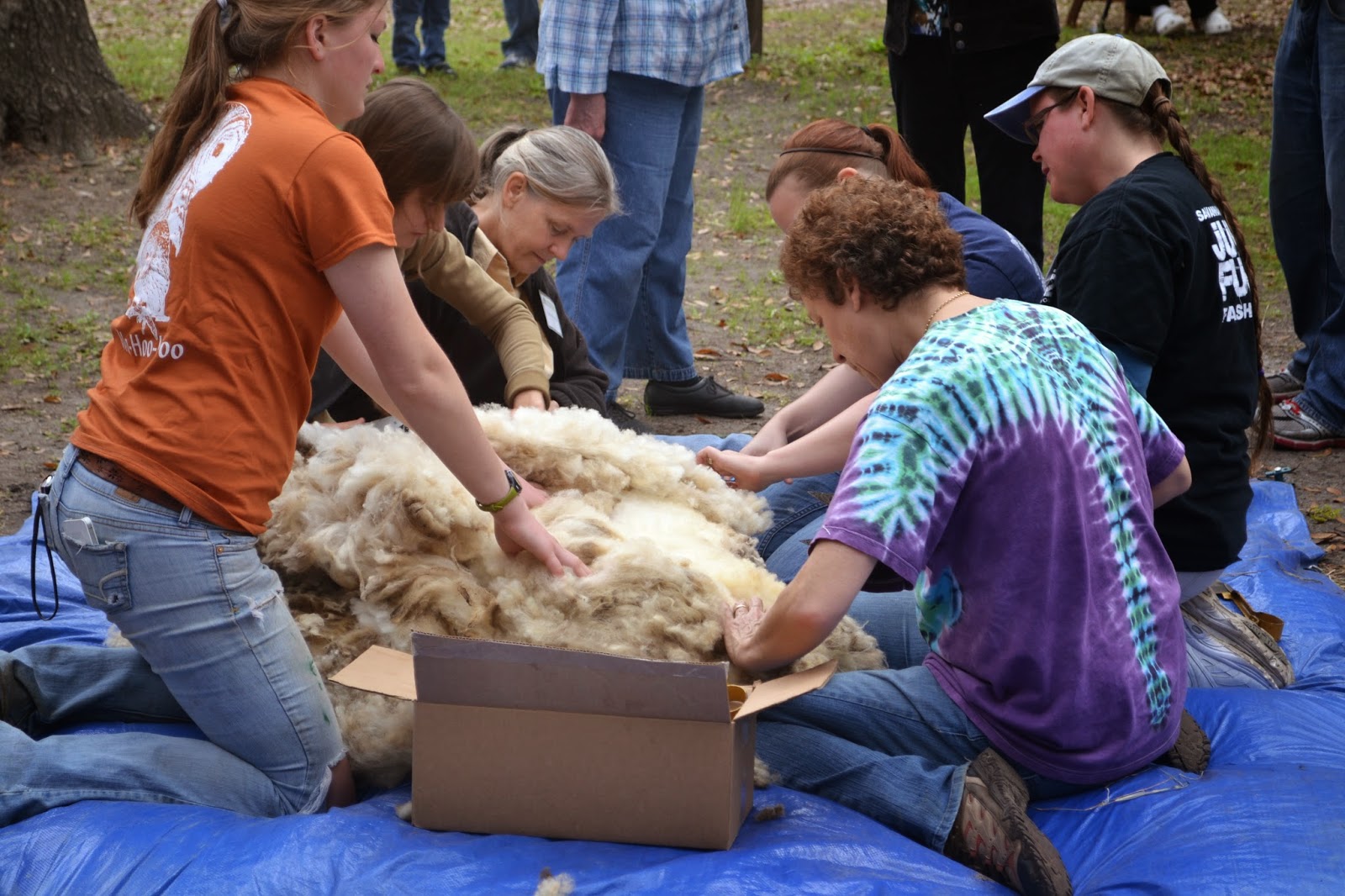


Someone's nephew practicing his hand carding…he promised me that when he grows up he will have a farm with four sheep and that Aunt Wendy could keep the wool.  An hour later after having so much fun at this event he revised his total to five sheep….we have not yet discussed the breed….


There was spinning of last year's fleece


Here's an antique wool wheel, begging for some restoration


Ginned cotton 


The shawl was actually woven from last year's fiber, which had been mill-prepped. I was expecting to see a lovely lanolin-y hand knit triangle produced on the spot, but that will be at another event!


There was also some dyeing going on;  here's an indigo pot


My darling nephew cracking black walnuts which then went into the dyepot


I would love to do this over an open fire!


And here are some other interesting sights 

This Scottish "shotgun" style cabin is a creation of Scottish southern forebears. I had no idea that the "shotgun" style building, where front and back doors are in line, and often seen in our Low Country beach homes, was Scottish in origin. It was moved from another location in Georgia and restored, it dates to to 1830's


Baking cornbread in a fireplace, the concave lid has hot coals placed on it


 A crusher for sugar cane


The cane is then boiled in a huge vat, they actually still do this and sell the cane syrup


The Coastal Empire Beekeeper's Association has been busy here. Here bees are getting a drink of water, the stones add needed minerals


Bison…no the soft under coat is not harvested


Sleeping wolf


Sunday, March 10, 2013

Rogue


done!  Soft and love it.  The extra band at the bottom to add length was an unusual stroke of genius, if I may....

Tuesday, May 15, 2012

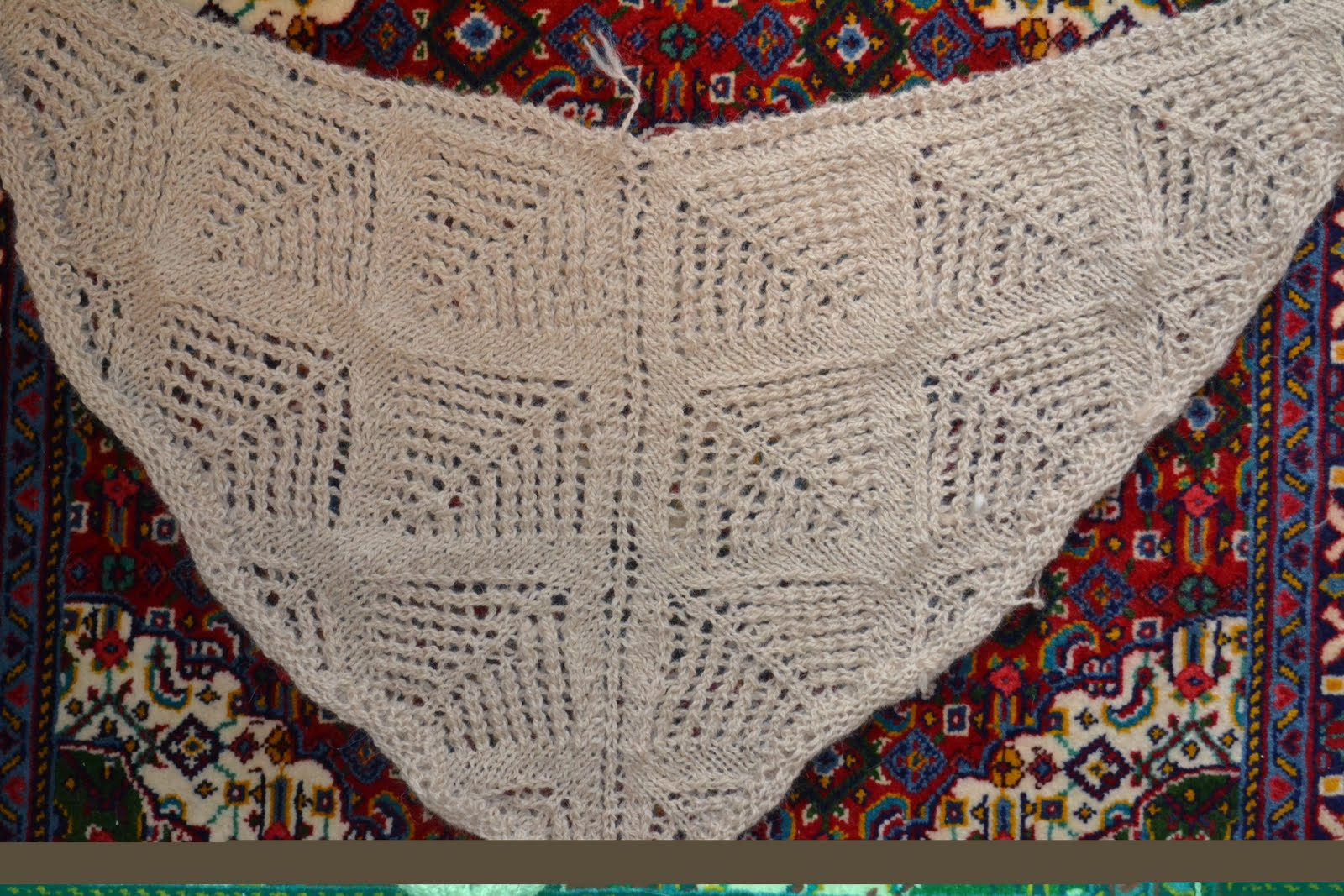
Pine Tree Shetland Shawl done

It's done and so is the preliminary pattern.  More stories about the development of my first shawl design here.

Two extremely nice friends are test knitting the pattern. Let me know if you roo would like to test knit, before I set it free on Ravelry!


Tuesday, February 28, 2012

Rogue Adventure

About 7 years ago, I found Rogue


 I learned about it reading Helene's blog.  (Helene writes excellent blog but my Norwegian isn't that great, so her photos and my guess work must suffice).

I had sworn about 15 years before never to knit a cable sweater again.  One should never say never.  I love this pattern, thank you, Jenna. I went to an upscale unnamed yarn store in an unnamed city and bought some yarn for it.  They did not have enough, and promised to send the rest, stating that "dye lots didn't matter for this yarn."  Like heck...don't ever believe that.

Finished Rogue in light green, with big streaks on the sleeves where the dyelots met.  It fit poorly.  The yarn met gauge but wasn't somehow chunky enough.  I think I actually put it in the trash!!  Maybe I gave it to my local charity place...

Anyway, I always vowed that I'd do another...after researching for a long time what yarn to use, I settled on Jamieson's Heather Aran from here.  This time in a natural cream.  I'm steaming along and loving how Jenna fit the shaping in to the cables.  Brilliant!  Ironically, when I did Rogue the first time, Jenna suggested using this yarn, which obviously as recounted above, I didn't.  But it's a pleasure to knit this sweater again.


 In my travels on the internet this week

Granted sells fabulous  chunky handknits.  Their prices might actually be fair for the handknitters. (People ask me a lot "how much to knit me a sweater?"  I dunno, 1K sounds about right...given how precious my time is and how many hours it would take...). While the label "Cowichan" cannot be used, there is certainly a strong resemblance.  My favorites at Granted are the wave and the mermaid. 

The Red Cross sponsored the Production Corps during the First and Second World Wars, and copies of official knitting patterns from WWII are available here.

I love Librivox, which involves the opportunity to listen to spoken versions of books in the public domain.  I just finished Jane Eyre and am now on to Moby-Dick.

Saturday, February 18, 2012

Lace design...goes on and on and on OR why I love a graph

I have been busy this week.  A while back, I conceived of a shawl.  This was after my trip to Scotland and I was enchanted.  I wanted to design a shawl that was like some of those I saw on my trip.  Most traditional shawls in Scotland are square in shape, and are either 1) functional working women's shawls or 2) fancy lace shawls originally knitted for sale to wealthy women.  I wanted to design one that incorporated the earthy-crunchy feel of the working croft woman's shawl, but with some added lace patterns.  I also wanted it in a nontraditional triangle shape.

I knew in my head exactly what I wanted to do...it is designed in my head.

For the first attempt, I wrote down the directions as I knit. There are many opportunities for mistakes over the course of 300+ loooooong  rows.

For the second attempt, I started a graph. I wrote about it here. The second shawl is cute (and alpaca!) and seen here.  But my graphing skills and perhaps my problem solving skills failed in the border.  I screwed up the border and must go back and redo it...later.

This month, I returned to the graph and the shawl.  So, I being my own test knitter.  Again.


I should add that I am using excel for this graphing task.  There are some internet resources to help me, discussed here.  And, it helps to have a teenaged son at home for some basics on how to move a graph chunk from excel to a word document (use paste preview).  Working on the graph is much more fun;  this will be a graph only pattern.

I am having more success this time.  Here we are so far.  But...I'm not sure after all these hours of work that it will be free...the yarn is from Harrisville Designs New England Shetland and is lovely to work with.

Tuesday, January 17, 2012

Shetland Tea Shawl

I have at long last completed my second handspun Shetland shawl.


I described the beginning of this project here.

As I mentioned, I searched for patterns that incorporated traditional Shetland lace motifs. I settled on the Shetland Tea Shawl by Dale Long, in A Gathering of Lace.

Now, to be frank, I'm not a huge fan of XRX Press and here's why  (I hope they are reading):  They produce some lovely books, but 1)I'm not a fan of oversized knitting books, hard to use  2) Too much "beauty" photography and not enough functional knitting photography.  I don't need to look at a huge lavish garden spread with a young model sporting a garment in a way that a young-ish person would never would.  And I couldn't see exactly what the center of this circular shawl looked like!


NEVERTHELESS I was really taken with the Shetland Tea Shawl.  I loved the circular construction which I had not done before.  EZ's classic circular shaping allowed me to use the different colors that I got from the yarn in concentric circles which made sense to me.  I did not do the border that is knitted on sideways as I knew that I was running out of yarn, went instead to the old standby Evelyn A. Clark border


  O                   O 7

  O


O 5

  O


O 3

  O             O 1


 It's upside down to the border shown below.

(Maybe one of these years I'll figure out how to use Excell to do this, or breakdown and buy the right stuff to develop and reproduce charts!)


It's really kind of a chunky throw but I really love it!


Tuesday, October 4, 2011

Old Shale Lace Shawl

 As I see it, there are four or so possibilities:

1) A traditional shawl pattern in a traditional yarn  ( a single breed yarn that is traditionally used with that pattern)
2) A traditional shawl pattern in a nontraditional yarn
3) A nontraditional shawl pattern in a nontraditional yarn 
4) A nontraditional shawl in a  classic single breed yarn (as might have been used in 1).


I suspect that my latest FO is an example of 2).  It's Evelyn A. Clark's Old Shale Lace Shawl, also at her website here.  We know that this is a "half hap" and that the traditional version is a (normal) hap shawl, a square with the old shale lace around the border.  While the wool (Shetland) is traditional, the dying is not, which is why I'm thinkin' this is a nontraditional yarn.  You can help me out here, I'm getting confused...


It is my handspun, about 16 wpi, made from a Shetland wool bumps from The Wool Shed in Orkney, Scotland, purchased in 2009. It's pretty scratchy but very lovely, Pam Murray was the dyer.  You know, just because the wool bump is soft doesn't mean the yarn will be.  But heck, I LOVE Pam's colors and its just the right size for over a jacket, either frontwards or backwards.

At the border I pulled out the points a bit to emphasize the pattern.  As I was blocking it, I kept thinking how enticing the old shale is, (the changing color does it justice) kind of the way the ocean is enticing...


Once again, thanks Evelyn and Sharon Miller

Monday, September 12, 2011

This was difficult?

I can be a lazy person.  A good example of something I'm lazy at is replacing my spinning wheel drive band.  OK, I'll make a confession, when it broke 6 months ago, I just retied it tighter and adjusted the wheel to accomodate.  How dopey is that?  So, when it started fraying again, and the little screw thingy under the mother-of-all started pushing in to the wood on the base, I decided it was time to wake up.  Actually, what really helped me to wake up was this article in KnittySpin which was I stumbled on at the right time.

Turns out, the operation was pretty simple.  Thank you, Lee.

I purchased some kitchen cotton at Michael's, appropriate for my single drive Ashford Traditional, put the mother-of-all at the neutral point, slid the yarn through my favorite whorl (reminding me of my favorite road bike gear), snugged it up, cut, and tied.  OK to leave the knot showing, per Lee.


I found something cool in my searching today, an antique rocker made out of spinning wheel parts, check this out:


sorry, it's sold.

On the wheel:  more Shetland for a chunky version of the Shetland Tea Shawl,
yeah, I'm as spin as I knit kinda person...


Sunday, August 21, 2011

Shetland Pi

So...finding another use for more of the Shetland Supreme I purchased while in Shetland...

I dyed a whole lot of natural white plus the other natural colors with some acid dye, can't recall.  Of course, in one of my favorite colors, orange and its tones.  I put too much in the dyepot.  This was at least a year and a half ago.  It dyed unevenly and I was unhappy with the result. 


Then some months ago I realized that I could separate the shades


(the spun up stuff is on the left)

and spin them separately.  I produced a two ply in more or less 14 tpi.

Of course, being myself, I wanted to use this Shetland yarn for something Shetland-ish.  Now while a circular shawl isn't, I don't think, a traditional Shetland THING, it still incorporates traditional Shetland lace patterns. 

 Last week, I was trolling about and thinking about pi shawls.  Realized that I had A Gathering of Lace on the shelf I found this


 It's Dale Long's Shetland Tea Shawl.

Here we are, so far.  It's a heavier weight than the original but I love it.  I will knit till I run out, putting the darker colors at the border.  Another reason to love a pi.  I also love the way the natural color changes are in the circle...my yarn is lovely and springy...maybe I am a spinner, after all...


Now that I've started, I may be hooked on the  pi shawl thing.  I may have to resign from the triangle lover's club (that is, the shawl triangle lover's club).

Saturday, August 6, 2011

Why is this so difficult?

I used to think that plants should be free, I liked to (and still do sometimes) thin them and give them away.  I think I feel the same about some knitting patterns. 

If there is nothing original about a pattern (such as a lace shawl with an old or commonly found pattern), why charge money for it?

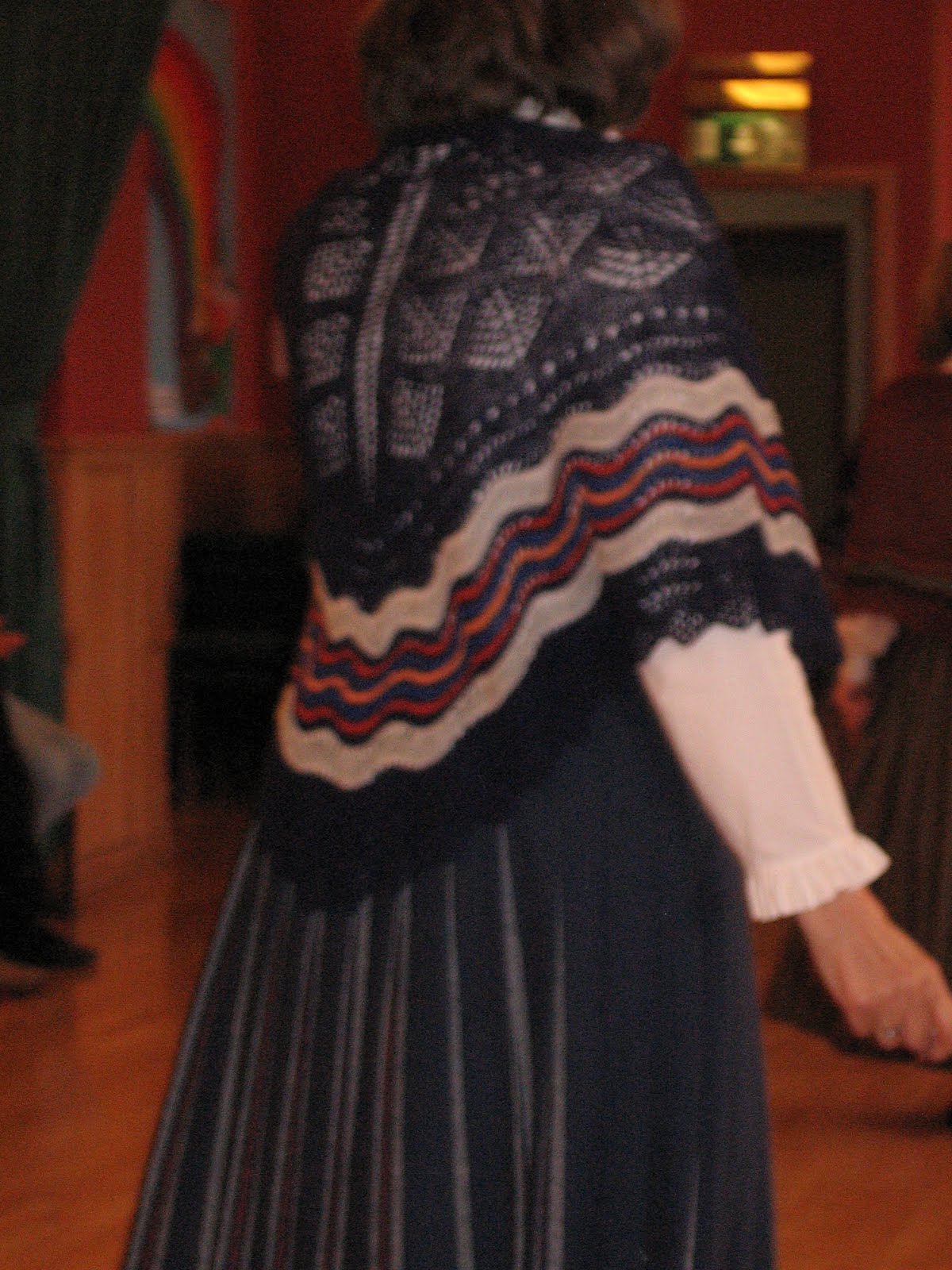
After I went to Scotland, I decided that I'd like to put together traditional patterns in a way that I had seen at an evening of country dancing.  The women wore skirts with vertical stripes, and triangular shawls to coordinate.  I've done an amount of book and internet research, and this doesn't look like a traditional Scottish hap shawl, as they were square.   They do look like hap shawls only done in a triangle, a "half hap" Joyce called it.

Even in Shetland on a cool summer evening, dancing is a hot business, so one can understand why they were wearing a "half hap."  They were done in various lace patterns, often with an Old Shale border, sometimes with the border in different colors.   But I couldn't find  any patterns to knit with this feature.   Decided to design one myself.

I decided that I liked the pine tree pattern with the old shale border. I knit one, and wrote out the directions as I knit.  Here it is, unblocked


But in this day and age, one needs charts.  Once I preferred knitting lace from text, now forget that. I looked around and priced computer resources for developing knitting charts, but didn't want to spend the bucks.  Then I found some very useful internet resources on how to use Microsoft Excel to chart lace.  Now, I've not used Excel except on one ill fated evening to try to plot out my monthly budget.  That effort was quickly abandoned.  This use of Excel looked to be much more fun.

Here are the sites I have used, many many thanks to the bloggers who have written up and shared their knowledge.


I set to work this June.  Oh heavens, hours, hours, hours.  It's addictive.  Like when you've lost something and can't stop looking for it. 


As a new designer, I've learning that graphing helps you to read the lace better, yet it can be confusing especially for triangles where new stitches come in at either side, and when matching up lace design elements correctly is critical.  One wants what one is sharing if not selling to be correct.  I've had to pull out the old shale several times to get both the knitting and the graph correct.  And believe me, this is pretty easy lace.

Here it is pulled out last week


So, should patterns be free?  Especially when using traditional design elements?  I have decided perhaps not, especially when spending a thousand hours coming up with the graph.  Now mind you, this has been a learning curve and I am definately still working on it.  Another test version planned, with more colors.

Nevertheless, yes, it will be available for free, when done.  

here are some photos of the ones I saw;  if you see your back or knitting design here on my blog and object, email me and I'll remove the photo...but they are lovely and I want to share...


Sharon Miller in her book Shetland Hap Shawls notes the traditional border colors.


Tuesday, December 28, 2010

Fair Isle Knitting

I haven't been to Fair Isle, just seen it in the distance from North Ronaldsay.  Here's a map showing the location of Fair Isle.


Fair Isle is part of Shetland, located 27 miles southwest of Sumburgh Head on the mainland of Shetland, and 27 miles northeast of North Ronaldsay, part of Orkney. 

Here's a photo I took at Sumburgh Head in Shetland, you can see the puffins, they are as cute as their name sounds


I don't know why this tiny island gave its name to the Fair Isle style of knitting.  I prefer to use the term  "Fair Isle" to this traditional style of colorwork of Scotland, and use the term "stranded colorwork" to refer to anything else.  It bothers me to see the term used for all colorwork styles.  However, there is so much culture passed along shipping routes;  see how close to Norway Shetland is...

Here's a sweater done in traditional Shetland colors, with a minimum of natural dying


I purchased Alice Starmore's famous book a long time ago;  Alice also speculates in the book on why this teeny island gave its name to such a tour de force of style


This book has recently been reissued by Dover Publications in 2009;  mine was published in 1988 by Taunton Press.

I think the only Alice Starmore pattern that I have done is a favorite, "Square Dance" 


I'm sure I did it in Alice's Alice Starmore Scottish Campion. (A campion, BTW, is a flower in the family known as "pinks" or "carnations").  My sons wore this sweater and it now hangs in my nephew's closet.  This is from Stillwater;  so why did I trash my copy as it now goes for $70 new on Amazon??

 I knit this vest below, now an old chestnut, but can no longer recall where the pattern came from;  I may have found a vest pattern and put it together with the classic peerie patterns, but I can't find either source in my book collection. "Peerie"  means "small" in Shetland dialect but I also heard it used in Orkney;  it also refers to the repeat in a Fair Isle pattern.


The yarn is a Green Mountain Spinnery single ply fingering weight that no longer exists.  I might wear this tomorrow to keep me warm,  it's cold here this month...