Showing posts with label spinning. Show all posts

Wednesday, October 26, 2022

Spinning Sea Island Cotton

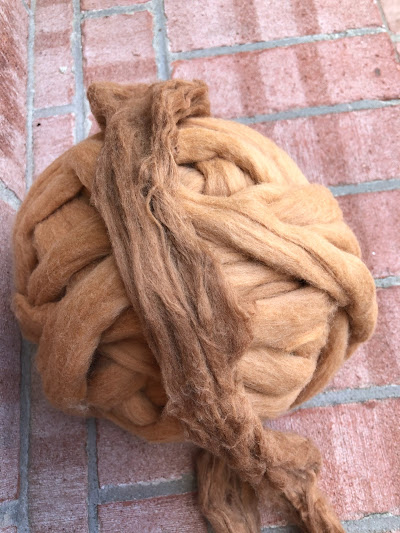
I love knitting with wool....it's pliant and forgiving as you knit. But it's not really practical for the climate where I live. So I am working on spinning cotton...probably not for knitting but for weaving. Here is my first effort on my Ashford traditional spinning wheel. This is Sea Island cotton that it supposed to have a "long" staple compared to "upland" cotton. But the staple is pretty short, I would guess 3/4 " or less. So one must pay attention while spinning...this first length is double plied. I bought 3 colors (they had five) from http://www.ewephoricfibers.com/ at the Southeastern Animal Fiber Fest last weekend.


I bought three colors, white, cinnamon, and green. They had 2 other colors that I didn't purchase. Here is an interesting thing: if you simmer the cinnamon and green in water plus baking soda, the color deepens.


Here are some cotton samples from my trip to Peru years ago...


Saturday, April 10, 2021

Rocky Mountain House Museum, Alberta

Not too many years ago, I had the chance to visit a friend in Alberta. We  stopped in Rocky Mountain House, I think on the way back from Olds College Fibre week. There's nothing that I like more than an old museum in a town, devoted to saving items from a town's and an area's history.   I look pretty excited on entering...


Rocky Mountain House started as a settlement, dating to the 18th century, as British and Canadian fur traders acquired furs from the First Nations peoples. Rocky Mountain House and Acton House functioned as fur trade posts from 1799 until 1876. Rocky Mountain House was owned by the North West Company; Acton House was established  the Hudson Bay Company.  The two companies merged in 1821. First nations peoples who traded included the Blackfeet, Piegans, and the Kootenays. I learned that pelts were transported east on the rivers. The Canadian reality show "Quest for the Bay" gave me an idea about the  difficulties in  transporting furs to the Hudson Bay in York boats.

Rocky Mountain House became a town after the trading post closed. Scandinavians were primary settlers to the area.   The museum contained wonderful items from the 200 plus years of the town's existence. The museum has a HUGE collection.


This is an old Scandinavian style spinning wheel, possibly Norwegian.


Drum Carder for sheep's wool.


This is an "Indian Head" for a spinning; these were usually attached to treadle sewing machine bases or a simple spinning wheel and were typically used to spin the thick wool yarns used in "Salish" and Cowichan" sweaters.  "Salish" and "Cowichan" refer to indigenous first peoples groups of the Pacific Northwest.  Here's an interesting article with more on this topic.


Oh my...


An old castle-style wheel


A double drive wheel, I'm guessing possibly Norwegian due to the slant...


Hudson Bay blankets were often made into coats. If it had a hood it would called a "capote." More information here. This may be new-ish.


 

Sunday, July 29, 2018

I love my drum carder

I got my drum carder several years ago for a song. I didn't realize how much of a song it was until I got home and priced them.  Mine does not have the manufacturer label except for a part that says "made in Canada".

Several members of my Guild, the Fiber Guild of the Savannahs (we have a beautiful new website, I'm happy to show it off), have been active in Tour de Fleece this year. It seems appropriate to blog about it today as it is the final day of the Tour de France for 2018 today, therefore the end of the Tour de Fleece. I often do better finishing a project with deadlines so I got some serious spinning done!

When I first got my carder, I was thinking that is was mostly for prep for raw fiber. Then I went to a workshop at SAFF with Esther Rodgers and learned a bit more.

Having some dyed roving around, it seemed appropriate to blend with the carder. I do find that spinning blended colors is a little more interesting...
Here are some process and results photos


Here is the resulting yarn. I'm not sure what type of wool it is, but it's pretty soft. I got the roving as color samples and used the "cool" side of the color wheel all  together.  It's pretty soft though. Spun on my Ashford Traditional and plied on my Louet. I use my Louet s15 mostly for plying but I should use it more for spinning. It has a very sturdy feel to it. 


Here is another yarn finished for the "Tour."  This is merino plus silk done in a single. Obviously, this is the other side of the colorway! You can see bits of turquoise silk noile.  Diana Twiss taught me to use the silk noile in handspun last year at Olds College Fibre Week. (She also helped me use the color wheel to think about my blending process). I can't wait to use this yarn for a shawl.


Sunday, November 22, 2015

Bobbin Boy...SAFF part two

Several years ago, I purchased an old 19th century spinning wheel and am working to get it functional. 


Wood and fiber just go together. As the daughter of an antique dealer, I of course find antique items interesting. So while I was at SAFF I was very happy to meet Milissa and Alan of Bobbin Boy, who restore old fiber equipment.  They have an array of videos at their facebook page and some diy tips for old fiber equipment. Here are some photos. Here is Milissa at an old wool wheel. Wish I had one...


An old adjustable skein winder


This lovely barn loom really caught my eye...


Do read this...most touching


Here is a form of clock reel also known as a "weasel" 


Alan will make bobbins for your old wheel...


Sunday, August 16, 2015

My old-new Louet S 15

I was lucky; I "came into" a new wheel. I knew someone who new someone who was getting rid of her Mom's fiber equipment. I visited and purchased...


Louet drum carder


Something with alot of 2nd cuts but horribly soft...cormo?


Clemes and Clemes carders


I am the proud new owner of a Louet S 15 wheel, no idea of the date. This is a bobbin lead spinning wheel.  According to Babe's Fiber Garden,  


If whorl is rigidly connected to bobbin, it's bobbin lead wheel. In this case a brake is applied to flyer whorl and this arrangement is called Irish, or German tension. Bobbin lead wheels are better suited for spinning heavier weight yarns, they usually have quite powerful take up, and fine adjustments are somehow tricky. As you spin, you hold yarn under tension and bobbin and flyer rotate together. As soon as you relax your tension and let yarn go, flyer stalls because of the brake, and bobbin continues to rotate, and yarn gets wound on the bobbin.

If whorl is rigidly connected to flyer it is flyer lead wheel, then the brake is applied to bobbin whorl and it's called Scotch tension (Babe calls it wonder tension). These wheels are very versatile, you can spin any weight of yarn on Scotch tension wheel; as wheel size and orifice size would allow. As long as you hold yarn under tension, flyer and bobbin rotate in sync. As soon as tension is released, bobbin slows down and flyer continues to rotate at the same speed, thus the yarn gets wound on the bobbin. Scotch tension is very sensitive and it allows you to spin very fine yarn on Scotch tension, or flyer lead wheels.

Double drive is a differential speed arrangement. Double drive wheel has drive band go twice around wheel - one time around the flyer whorl and second time around the bobbin whorl. This arrangement causes the flyer and bobbin to rotate at different speed all the time (they have to be different diameter, or there will be no take up) and provides very steady take up. Many people find double drive wheel tricky to handle and these are definitely more difficult to build.


Yes, it's true, I should have learned all this some years ago!  OK, so apparently I have a very different wheel than my Ashford...can't wait to try it, perhaps it will be good for plying!  I have a "footman replacement kit" ready to go and then I may be in business.  I later figured out that the yarn winder mounts on top of the wheel...clever...


Tuesday, March 10, 2015

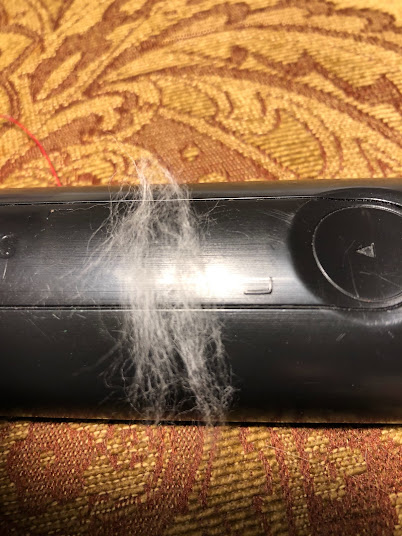
Adventures in Spinning Cat and Dog Fur

CAT FUR SPINNING

I do not own dogs, I have two cats.  I used to have  a white Persian, I was the poor thing's third owner. His name was Gable, perhaps an earlier owner named him after Clark.  He was rather neurotic and was a former Bronx resident.  I recall that he had lived through a fire in the Bronx. (I used to live in the north Bronx so I felt a bit bonded with Gable on that part...). The person that I got him from had a child with allergies and needed to pass him on to a third home.  Here is a portrait that my son R did when Gable was with us. The downturned mouth/jaw kind of says it all!!


But he was very sweet and declawed. I saved his fur and spun some yarn, using a puni rolags (this is not the time or place to define puni rolags, sometime I'll go there...), I spun it then  I double plied it. 


Gable is gone now, for several years, and I'm still not sure what to do with this bit of yarn, which is very soft.  Perhaps knit a star to represent Gable's star in the firmament. He had a hard life and I hope that he was happy with us!

(My current cats are  Domestic American Shorthairs and their fur is fairly useless on the spinning front, however they are great pets. Both are female and there is only the occasional territorial fight.)


DOG FUR SPINNING

A friend of mine from work acquired a Landseer (kind of like a Newfoundland but not quite) named "Mariska" a couple of years ago. 

Here is Mariska, lookit that tail wagging...she KNOWS her photo is being taken!


Knowing that Mariska's fur had a relatively long staple (fiber speak for length), I jumped at the chance to spin it up. Jim has been diligent about bringing me bags of fur.  It is at about 7 wpi and pretty makes a bulky yarn.  I roughly separated the darker from the lighter fibers and spun them separately.  Here's the darker yarn


I had an inspired idea...knit a dog from dog fur. I found a pattern, amazingly enough, for a Newfoundland dog. Shaped quite like a Landseer. After some spinning had happened I realized that the pattern was crocheted, not knit.   I mentioned this to Jim who enthusiastically said "oh but my Mom crochets!"  

Here is the pattern,  results to follow...


Wednesday, October 24, 2012

Bad Planning and a finished Chullo

I have spent WAY too many hours in the last couple of months re knitting things.  Like, hours and hours and hours. For garments, I usually swatch, but even when I do sometimes things don't fit.

And even if something doesn't need a swatch I decide, despite 50 hours more or less of work on it, that it's the wrong size, or I'm doing the wrong item (scarf vs. wider dresser scarf...), I frog and reknit.

For example:  I have some handspun which I did several years ago. Early handspun effort.  I loved the colors by Gale in the initial roving, but once spun up the lavender tones were...well.. a little too dim and undecisive for me. (A nice way of saying that pale pinky lavender makes me nauseous, even when offset by yellow...).  In an effort to destash, I pulled it out, decided that the yarn would look great in  the Morning Surf scarf pattern.  I had seen it in a 2008 issue of SpinOff and apparently it's now available for FREE! In the initial spinning I added some beads. It looked like dresser scarf project when I started the clever pattern, then realized that the beads at one end destined it to be a neck scarf.  I've started this FOUR countem FOUR times in different widths.  Hopefully now I've got it right.


The pattern does REALLY WELL at bringing one's eye to the unplanned color variations. Despite the fact that this is an early spinning effort,  I will give this away.

SO with all the reknitting this summer and early autumn, it was with EXTREME PLEASURE that I FINISHED something.  Son B requested a chullo in Clemson colors.  Yes, Virginia, there IS a Clemson group on Ravelry!!


B has a large head, relatively speaking.  (I also had to start this project several times but as it's bulky weight, it finished quick once I figured  it out...).  I found, thanks to Bernat, a top down chullo pattern.  (All of the prior chullos in my life were bottom up...). The pattern is in this free ebook. Oh, thank you Bernat.  Thus, I could knit until the crown fit B's head.  He loves the photos I've sent...I'd better get it to him before football season's over!!

Saturday, September 1, 2012

Spinning flax


I am interested in learning how to spin flax. I know that this is a huge part of our fiber heritage. Several of my favorite resources discuss flax culture.  In the chapter on flax culture in Home Life in Colonial Days originally published in 1898,  Alice Morse Earl discusses the importance of each American household being self-sustaining:

No farmer or his wife need fear any king when on every home farm was found food, drink, medicine, fuel, lighting, clothing, shelter. Home-made was an adjective that might be applied to nearly every article in the house. Such would not be the case under similar stress today. In the matter of clothing alone we would not be independent. Few farmers raise flax to make linen; few women can spin either wool or flax, or weave cloth, many cannot knit. (This was 1898 when she published this!) In early days every farmer and his sons raised wool and flax; his wife and daughters spun them in to thread and yarn, knit these into stockings and mittens or wove them into linen or cloth, and then made them into linen or clothing. Even in large cities nearly all women spun yarn and thread, all could knit, and many had hand-looms to weave cloth at home.   

(This quote is on pp. 166-67 in the edition that I own which is copyright 1993 by Berkshire House Publishers).

Of course, Mrs. Earl is discussing this relative to colonial America, whereas she also makes reference to flax culture being at least 4000 years old, there being representation of flax culture in the art of ancient Egypt.

Note, linen is the fabric woven or knitted from fibers of the flax plant. 

Of interest to me, of course, is her mention of early efforts at South Carolina flax culture which I discussed in a post several years ago, a section of which is quoted here:

It’s clear that flax culture was critical, as linen provided the coolest garments... Alice Morse Earl's excellent research for Home Life in Colonial Days revealed a letter from Major Lucas to Eliza dated 1745; in which he documented sending her via sloop (from the West Indies, presumably?) two Irish servants, a weaver and a spinner. He ordered flax seed sent to her from Philadelphia. The two Irish women were charged with training slaves to spin flax and weave clothing for the slave population. Eliza had spinning wheels and a loom made, and a "sensible negro woman and hundreds of others" had learned to spin. Mrs. Earl's followup comment is "excellent cloth has always been woven in the low country of South Carolina, as well as in the upper districts, till our own time" (p. 183) (e.g., again, a. 1898). She may have been alluding to the textile industry that is still active in upstate South Carolina).

Manual flax production from the plant has multiple steps, involves many tools,  and is very physically demanding.  Undoubedly,  the small amount that I purchased recently from Wild Fibre was produced using some industrial process. 

So...when my friend Deb was here, I got a tutorial.  I was relieved to learn recently that my spinning wheel, an Ashford Traditional, is perfectly good for spinning flax.  I needed a bowl of water at hand to keep the threads moist as I drew them out.  It was very easy to spin a fine, if a bit uneven thread with a high twist.  Now...to finish spinning and figure out what to do with it...


Friday, August 10, 2012

Beach Knitting

Beach vacation...St. Augustine

Sand on my treadles (I didn't take her to the beach but that might have helped her uneven finish...)


Trip to beadstore for the right beads (found The Bead Chick)


Discovering wire knitting with strands finer than hair


Dolls are better dressed now


No, my Ravellenics project is not done...but the skirt is progressing...

Even teenaged sons have some fiber activities


 (I might need to learn how to do this...)


Spending too much time on ancestry.com...but feeling righteous about it ...in a family benefits sort of way...