Showing posts with label Peru. Show all posts

Thursday, December 5, 2013

Where does your tee shirt come from? or…thoughts on not-local

A bit of diversion from my usual…Where exactly does your tee shirt come from?


I was listening to NPR the other morning and they were airing a Planet Money segment

http://seedtoshirt.tumblr.com

They made their own tee shirt from "scratch." You really should watch this.  Basically the voyage is:  cotton grown in Mississippi, to India for spinning, then either to Bangla Desh or Guatemala for sewing, then back to the US.


Here is some natural cotton from Peru…it grows there too.  I love the green tone


It was a gift when we visited  a cotton packaging operation in Lima, here are some bales


I haven't yet tried to spin it…hopefully I won't need a charka a la Ghandi…they've been spinning cotton in India for a LOOOONG time


but who doesn't need a new spinning tool?  Here's a cute contemporary charka from Ashford


OK, diverted by fiber tools... anyway..

So how do tee shirts and their components get from continent to continent?

Interestingly, I was in Savannah about 2 months ago…on River Street with my sis and her family at Octoberfest.  A big Maersk container ship was cruising out of the port.  My brilliant sister googled the name of the ship on her cell and was able to see that it was going from Savannah to Houston.  Houston?  I though these ships only went overseas?  Did you know that you can track the path of a container ship at the Maersk website?  Did you know that Maersk is a Danish company?  Here's a cool site where you can see where their fleet is. And did you know that the Maersk seven pointed star represents the seven seas?  And did you see Captain Phillips?  I was shocked at the small size of the crew…


So, doesn't all of this international shipping crap
er… stuff make you happy that you can know exactly where your hand knit or crocheted sweater, scarf, shawl, mitts or even "tee shirt" came from?   The alpaca farm up the road?  The sheep farm in Vermont?  The angora in the back yard? The cotton grown down the road? And you know…how many cotton tee shirts do you or I really need?  Could we actually make our "tee shirts" local?

Here's one tee shirt that I really do need (from Wild Fibre in Savannah; I have a pink one too)…but where did it come from, exactly?


Well, the label revealed the final step…"hecho en Guatemala."  The brand is "Bella"…I do like the cap sleeves, won't wear  a tee shirt without a lady-like cut...


Ya know, I could have gotten a degree in textile engineering…..Roseanne Rosannadanna would say that I have alotta questions in this post. Would she say "follow the money"?  

Saturday, October 13, 2012

Susan's travels and more Peruvian textiles

I am lucky to know  three people (on two different trips) who have hiked the Inca trail to Machu Pichu  in the last two months...as you might know, I myself merely took the train and the bus...

AND my friend Susan who I stayed with last weekend on a quick trip to Massachusetts has also been to Peru as well. Susan shared some of her handknit and backstrap woven purchases.  I only had my camera to photograph with so the photos are not great...


I love the brilliant green and black hat and the motif of the second woven strip.  Both hats are alpaca.

I did some internet searching and came upon this great thing


Apparently this was the garb of the Peruvian downhill ski team during the 2010 Winter Olympics.  How grand!  Wonder what the fiber was?  Here's a link with more:


http://blog.oregonlive.com/knitting/2010/02/knitting_in_the_actual_olympic.html

While visiting Susan and Son R, R and I went to the MFA, one of my favorite places.  I hadn't been there in years.  The highlight of the visit was this


These are REAL taxidermied hummingbirds turned in to a brooch and earrings, done in the 1870's in England....The link to an MFA site with more discussion is here.  You can't see from the photo, but the beaks are gold and the eyes, rubies.  They look a little like scared hummingbirds with Buckwheat haircuts, don't they?

Ironically, after arriving back home, I was watching my feeders on the porch the other night.  It was early dusk and I could see the red rim around the humingbird feeder but not the small thing flitting around it.  (It's almost the end of hummingbird season here although I have an acquaintance who had one at her feeder all winter last year.) At first I thought it was a dark little skipper, but after a bit I realized that it was a juvenile hummingbird.  Magic!

Thursday, January 12, 2012

Glove palms and a doll

OK, so we went to Charleston (that's SC) for an overnight during the holiday and visited the Charleston  City Market.  There was a Peruvian lady there selling alpaca handknits...the boys each bought a chullo in natural colors, and R got a pair of gloves.  


Thinking that perhaps the gloves needs some palmar traction,  I purchased some mitten palms from Halcyon Yarn (the only place I could find them, I actually made a purchase there a long time ago during a visit to Maine), shortened them a bit, put some additional holes in with a hammer and a small nail, and sewed them on...voila!

I am having way too much fun birthing a Theodora (also available here)...


She has brown hair (like me). I like not being bored while I knit (e.g. I prefer no vast wastelands of garter or stockinette...) and like a lace pattern. Similarly, with doll knitting,  there's lots of shaping to do  to keep me busy.  Thanks, Helene!!  I suspect that various family members (me, my Mom, my little neice) will all want one, so I suspect more Theodoras will follow...


Monday, June 6, 2011

My Peruvian Hand Spindle

I am trying to learn more about drop spindles.

When in Peru in summer 2010 I bought this little drop spindle


 I just discovered Abby Franquemont's blog.  In this post she discusses these Peruvian low whorl spindles.  Apparently the dark marks on mine may have been created by woodburning.  And apparently they are hard to find in the US, easier to go to Peru to purchase one. 

I could learn alot more about spinning if I actually took the time to read more of Abby's blog.  But the post I mention is fascinating, and Abby talks about how to easily make a similar spindle of your own with a trip to Home Depot or similar.

I bought my spindle above at the Center for Traditional Textiles of Cusco in Chinchero


 Here are some of the ladies spinning on the same sort of spindle:


And a poorly labelled but interesting video, courtesy of Youtube


 At another branch of the Center in Cusco, on a main boulevard


Could I look any happier?  I am wearing a bit of backstrap weaving, which was done by a schoolchild!

 I might recommend this


it's available here.

It has alot of basic spinning information for the novice not very good spinner like me.  Also some direct projects for knitting with handspun.  Abby has a couple of articles in it too, including one on high vs. low whorl spindles. 


Tuesday, November 16, 2010

The Chullo Continuum


As in many cultures, larger traditional clothing garments in Peru are woven.  I notice that smaller functional mittens, socks or stockings, hats, and occasionally sleeves  traditionally were handknit, as opposed to larger garments.


In summer of 2010, our tour group saw beautiful handknit chullos.  That's a llama wearing the chullo above.  An alpaca wouldn't stand for it.  One of my travelling companions taught me  that "llamas are like dogs;  alpacas are like cats."  A vicuna in a hat?  Forget it.


The word "chullo" comes from the Aymara word for a hat with ear flaps. (Aymara is spoken by the Aymara people in the Andes, in an area including parts of Peru, Bolivia, and Chile.  The three primary languages spoken in Peru are Spanish, Quechua [also a native language], and Aymara.)  Chullos in South America are of course knitted from natural materials:  vicuna, alpaca, llama, or sheep's wool.


At the Center for Traditional Textiles of Cusco, my tour group saw some examples.  Here's a pretty bad photo of a chullo in progress, but it gives you the idea of the gauge that the knitter was working


 We also saw an example of a sleeve or "armwarmer"


I love the geometric birds, and the contrast of the black and white with the colorwork.


Later, we went to the Center's workshop in Chinchero


Here's an example of a chullo in progress, you can see the longer "tail" on this particular hat


The women participating at the center tended to switch crafts, although  master (I prefer "mistress") artesans stuck to their highly crafted skills, as I suspect this knitter did


The chullos I have created are a little different.


If you can place an extremely fine hand spindle spun wool, alpaca, llama, or even vicuna at one end of the continuum, what goes at the other?  Why, Red Heart Super Saver from Walmart, of course.  Now, while I don't always consider this a REAL fiber,  I knit with it, and here's why:


I have two teenaged sons.  When they were small, I thought that I would be handknitting sweaters for them throughout their youth and in to adulthood.  Well....no.  However, the one item that they do like handknit is hats.  According to my source, chullos have become popular in western cultures due to British rapper Dappy.  When knitting their chullos, I use that Red Heart for its ability to reflect B's high school colors, and its durability in the wilds of Maine


Here's the pattern that I base my chullos on.  I do a gauge swatch, measure head circumference, and reduce the number of stitches given in the pattern, adjust the graphs accordingly.


Red Heart easily survives a dunking in the Allagash River 


Saturday, August 21, 2010

Vicuna Chaco in Picotani Part 2


After the vicunas were led into a small corral, we were then lead in to the community center with the entire community sitting around the perimeter of a large room; we honored guests
got chairs! A group of local musicians inmatching vests with intarsia'd vicunas sang for
us.


Then, the children, dressed in traditional costumes which perhaps were Sunday best danced a story for us.


At that point there was more formal dipping of coca leaves in to various alcohols. We were offered small shot glasses of a sweet liquor. I steeled myself and sipped. I was not worried about what I was drinking, rather, the cleanliness of the hands that had washed the glass and poured the drink!

Two one year old vicunas were then chosen to be bride and groom. They were brought in to the large community room and decorated with ribbons, shaking only a LITTLE bit with fear! Then, two of us travelers including myself were chosen to be best man and maid of honor(!) for the pair. Gerald and I got to name them, then ear tags were cut; they did not seem to have too much pain with this! We all had blood smeared on our cheeks.

We then went out to watch the shearing of these two little ones. They were fearful, but did not bleat loudly and fearfully as I have heard alpacas holler while tied down for shearing.
Then, two women demonstrated skirting and removal of guard hairs from the sheared fleece.


After that, that, the women put out their wares, which were similar to those available at the roadside stands: handknits, handwovens.


I bought a beautiful scarf done interestingly in what I think is a traditional Shetland leaf pattern, in natural alpaca. Above is a photo of the knitter, who allowed me to take her photo.


Wednesday, August 11, 2010

Peru: Mallkini Alpaca Ranch


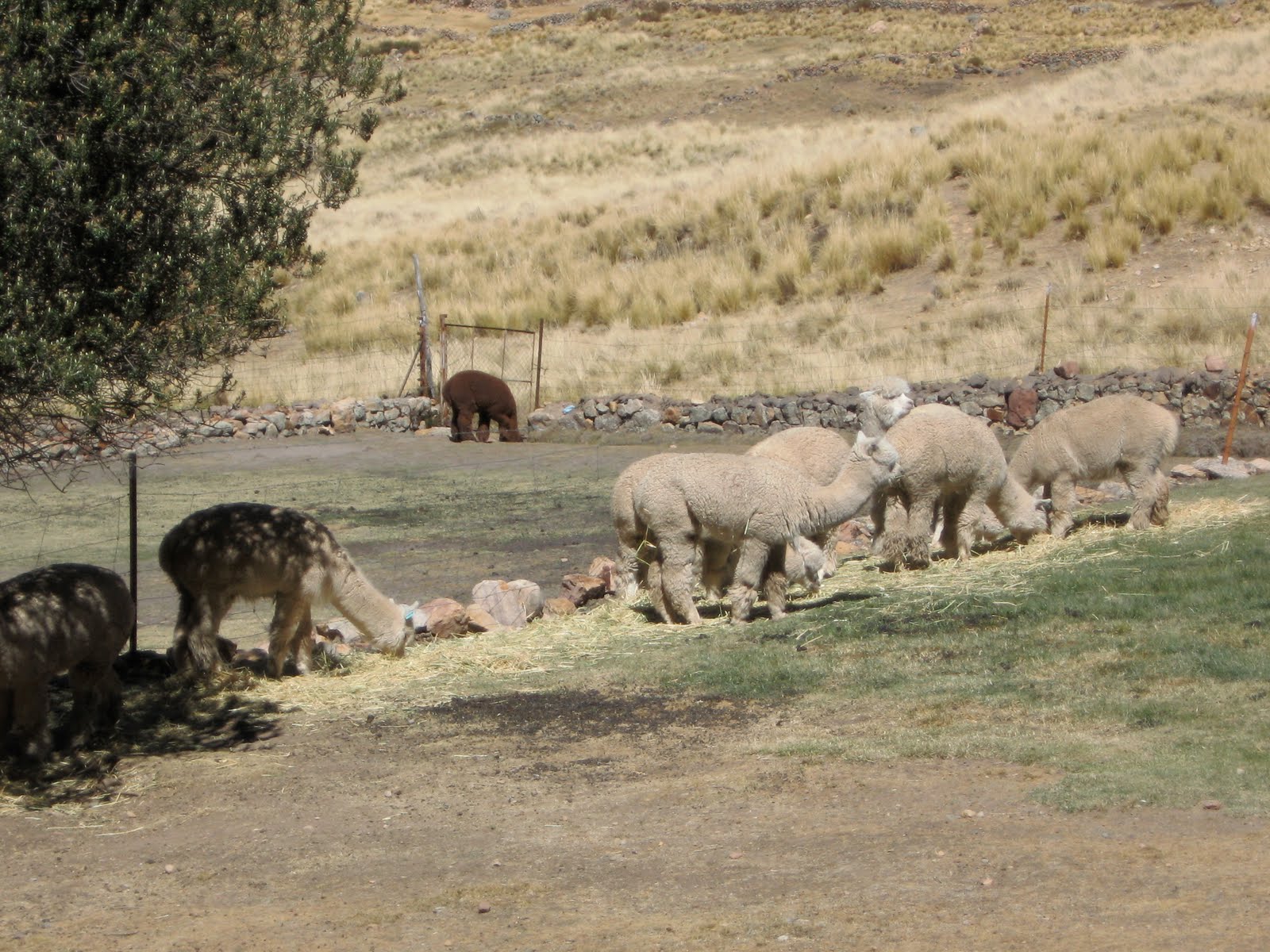
Mallkini Alpaca Ranch is located in the province of Puno, which for us was a long bus ride from Arequipa. The ranch has a guest house, and is remote. The elevation was about 15,000 feet and despite the altitude sickness pills, I felt easily short of breath with a quick 30 foot walk. The soft fleeced alpacas above are kept in front of the house, pictured below, for show. The majority of the animals are scattered over thousands of acres and looked after by shepherds. Mallkini is a breeding center, where animals are bred for color and low micron count (fineness of fiber) among other things. The dark brown animals, such as those seen below, are highly prized as they are fewer in number. This website has a nice discussion on breeding for fiber quality.


The herd seen at left is a prized one, that we drove several miles to view one morning. At left is a mama and baby.
The ranch house is pictured below. There was a lovely fireplace to keep warm around after dinner, while

sipping wine or mate de coca tea.


Tuesday, August 3, 2010

Machu Picchu: A Near Fiber Free Post

While all of Peru was amazing, everyone knows and asks about Machu Picchu. Our group actually visited there towards the end of our trip. No, it was not the highest point that we visited: that was Picotani at 17,000 feet. Machu Picchu is about 8,000 feet, and I was no longer taking altitude medication by the time we got there. The air was a bit thin, however, and there was a little shortness of breath with lotsa walking or climbing stairs, of which there were many.


We took the train from Cusco (11,000 feet) to Aguas Calientes.
Much of the track had been rebuilt since the floods in spring of this year (2010) and discarded tracks were seen along the Urubamba River, which ran along the train line. Above right photo is of our train on a curve; the white area on the mountain is actually a landslide. Aguas Calientes was notable for our incredible hotel, Inka Terra, and for a huge tourist target market ("mercado"). The following day we boarded a bus at 7:30 am which took the switchback laden Hiram Bingham Highway up to Machu Picchu.

Stepping through the entry gate to see the city was pretty thrilling. The Incas built this facing the morning sun in winter. Somehow, archeologists have confirmed the uses of many of the buildings and spaces. Of course, there are terraces on which the Incas farmed, exploiting different elevations for variations in temperature, water, and soil nutrients. Bromeliads seen in the photo at right.

Below is a photo of me next to the Sacred Rock, the outline of which mirrors the outline of the mountains behind it.


OK, so it's not an entirely fiber free post; there were a number of llamas roaming and grazing. No, I was not one of the dopey tourists feeding them crackers.

Llama is not as soft as alpaca and is not bred

for color as alpaca is. But the fibers are soft and lofty for spinning. Llamas are friendlier and larger than alpacas, and look cute in hand knit chullos if one has a mind to dress one up. The lady at left did. She was at a scenic spot where our bus stopped for a photo op. She had her llamas at the ready for a photo in return for a couple of solas.