Sunday, August 25, 2019

Cold Harbour Mill and some thoughts on mills

May brought for me a fiber tour of Cornwall; on our way there my tour group stopped in Devon. We visited Cold Harbour Mill which is a working museum in Uffculme, on the River Culm. Cold Harbour is one of the "oldest working mills in the UK having been in continuous production since 1797" according to their website.   It was a two  and a half hour ride west from London just off the M5. 


We had a lovely lunch before the tour. I did not have ONE BAD MEAL in England. I think that the bad food reputation is due to the privations during and after WWII .  Here is the pub scene at noon on a Sunday. My lunch was excellent.


Then on to the mill. It is in a lovely setting and is well maintained. 


I try to listen closely to a tour guide when touring mills but I still don't understand what exactly all the machines do. But I think they are all very ingenious and beautiful. 


Puttees were made in this factory... the company had a steaming process that helped puttees mold to the legs. I was surprised at the number of countries in which they were worn. But then of course, the British empire and the influence on current and past holdings was immense, and I suppose that the puttees were a practical way to dress in many unfriendly environments.  


This was the air raid room for use during WWII


I always think of the poor people, often children, who were probably considered lucky to have jobs in these places, spinning cotton and wool into threads with little or no safety concern.  

I found the BBC program "The Mill" on Amazon prime, which has given life to this setting for me. The irony that the mill owner's wife was "antislavery" and yet the child workers were beholden to work in the mills is the ironic touch.


Thursday, August 1, 2019

FO: Elizabeth Shawl from North Ronaldsay Sheep


I have probably noted before that sometimes yarn must sit in stash for a while before it tells you what it needs to be. Such was the case with this yarn purchased on North Ronaldsay. It was sheared from North Ronaldsay sheep ON North Ronaldsay. The yarn was also processed and spun on North Ronaldsay.  The sheep are special and supposedly their wool is soft because they eat seaweed.


 I went to Scotland 10 years ago...I've been waiting THAT LONG for this yarn to tell me what it wanted to be.  It has been cast on and then frogged for perhaps 5 projects before this one.

North Ronaldsay is one of the islands in Shetland.  We took a day trip there during the tour, taking a small plane from Lerwick. The pilot looked a bit like Clooney.


When I buy a yarn from a different country, I want the yarn to speak to me, and either the yarn or I express the need for it to be something related to that locale.


I ran into Dee O'Keefe's Elizabeth Shawl a while back. I actually first tried this yarn in Dee's Elizabeth Wrap, but it didn't seem right. (A triangular shawl, while not traditional, always seems right.) The shawl has traditional Scottish lace patterns.

The yarn is soft and has the usual nice wooly spring to work with. I started it before a trip to England in May. Perhaps I was inspired because I was with the same tour guide as on the Scotland trip!

The yarn is a two ply fingering weight with a gauge of 4 sts per inch. I love this shawl.

Saturday, June 8, 2019

Little Triloom Ponchos

I have completed two little triloom ponchos and a small shawl so far this year, all done on my "lace dent" loom. "Lace" isn't really the right word as the "dent" is 3/8  inch, hardly lace.  But I double and triple up on a worsted weight yarn and it works. I haven't found a loom with a smaller dent, not sure that they exist.

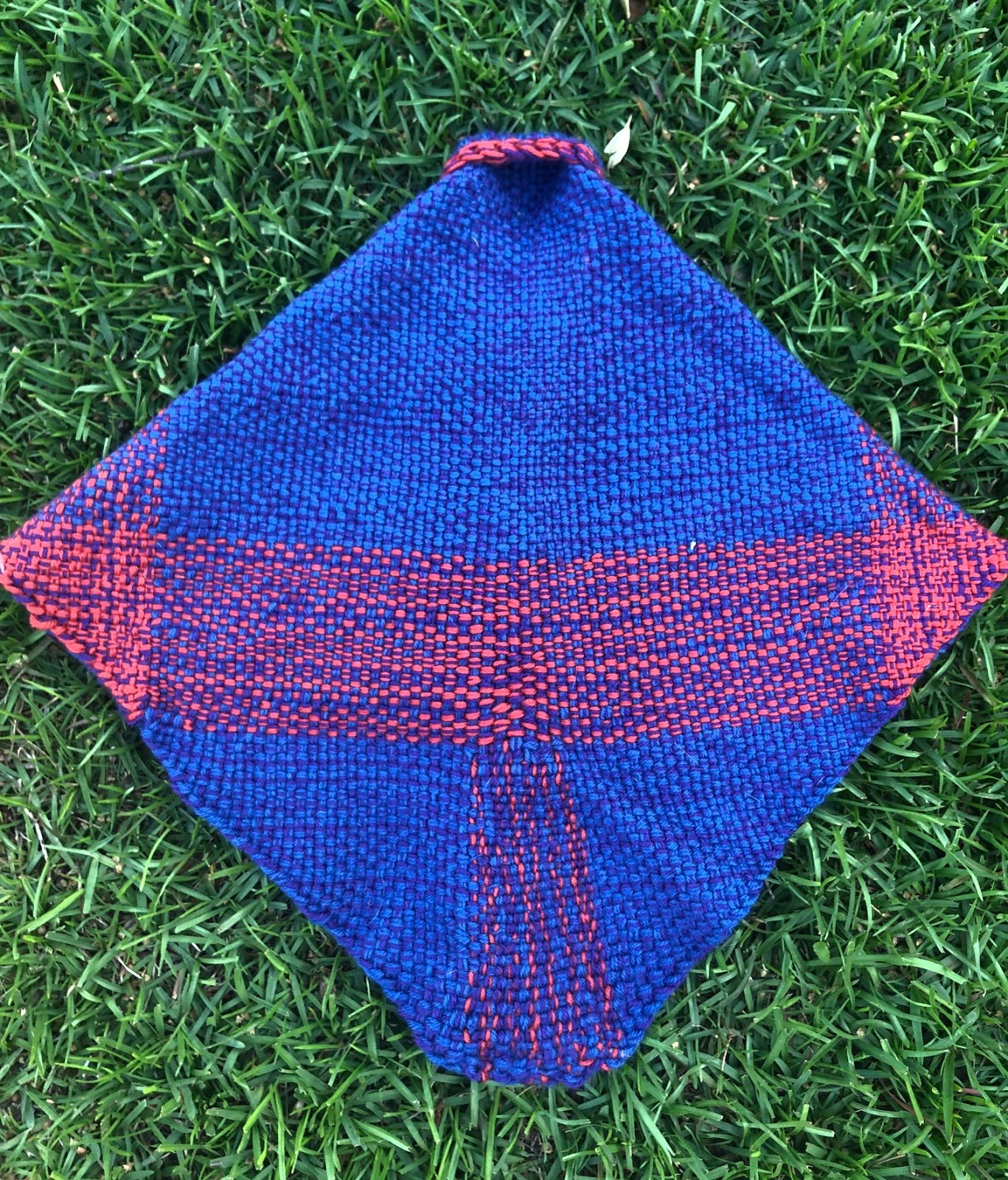
I wanted to be able to weave some items for "Hats and More for War Torn Syria" group on Ravelry. Via the Salaam Cultural Center in Seattle, this amazing group sends items to Syria and places where Syrian refugees actually wind up.  I figured out that I could "fold" my finished piece into a poncho shape and add buttons.  One of the added benefits is that one uses one's yarn faster than with knitting (!)

Here, my friend's 5 year old models an unfinished poncho, he said very cutely  "but it needs buttons!"  I crochet an edge and add buttonholes and of course buttons.


Here are completed ponchos, with buttons.  This one was done from naturally dyed wool (I didn't dye it)


Here is another, front and back. I used as above 3 strands of worsted weight, in with the blue one one strand of purple, making it lovely and vibrant.


The bottom of the back had very loose weave so I hand wove in some threads. I liked the effect, actually. 


I hope that these will be functional garments. They could of course be head or neck warmers.

Sunday, March 24, 2019

Huipiles I own and a free huipil pattern or two

I love huipiles...you know those  tops originally from Guatemala and  Mexico that can be elaborately embroidered.  They are created from a flat piece of cloth and thus are an easy "canvas" for creativity.

The V & A has a fabulous article on huipiles, the colonial style Mexican blouse, and rebozos.  According to this article the concept for the huipil, from Mexico and Guatemala,  has "evolved" over 2,000 years. Originally it would have been backstrap woven and would have been created from one or two wide strips of clothing.  Designs could be woven into the cloth.

This blog post, an interesting fashion read on what people of mixed race wore in 18th century Mexico, shows a woman wearing a huipil in  Frame No. 7.

I visited the Museo de  Trajes in Bogata in 2017; here is a photo of a Mexican huipil fragment that I took there, note the beautiful pickup woven inlays


Here is one that I purchased at Frida Kahlo Museum in the museum shop (Frida culture  has popularized huipiles). It is of muslin, the width is just over 24 inches, with the selvedges used so that the arm holes did not need finishing. 


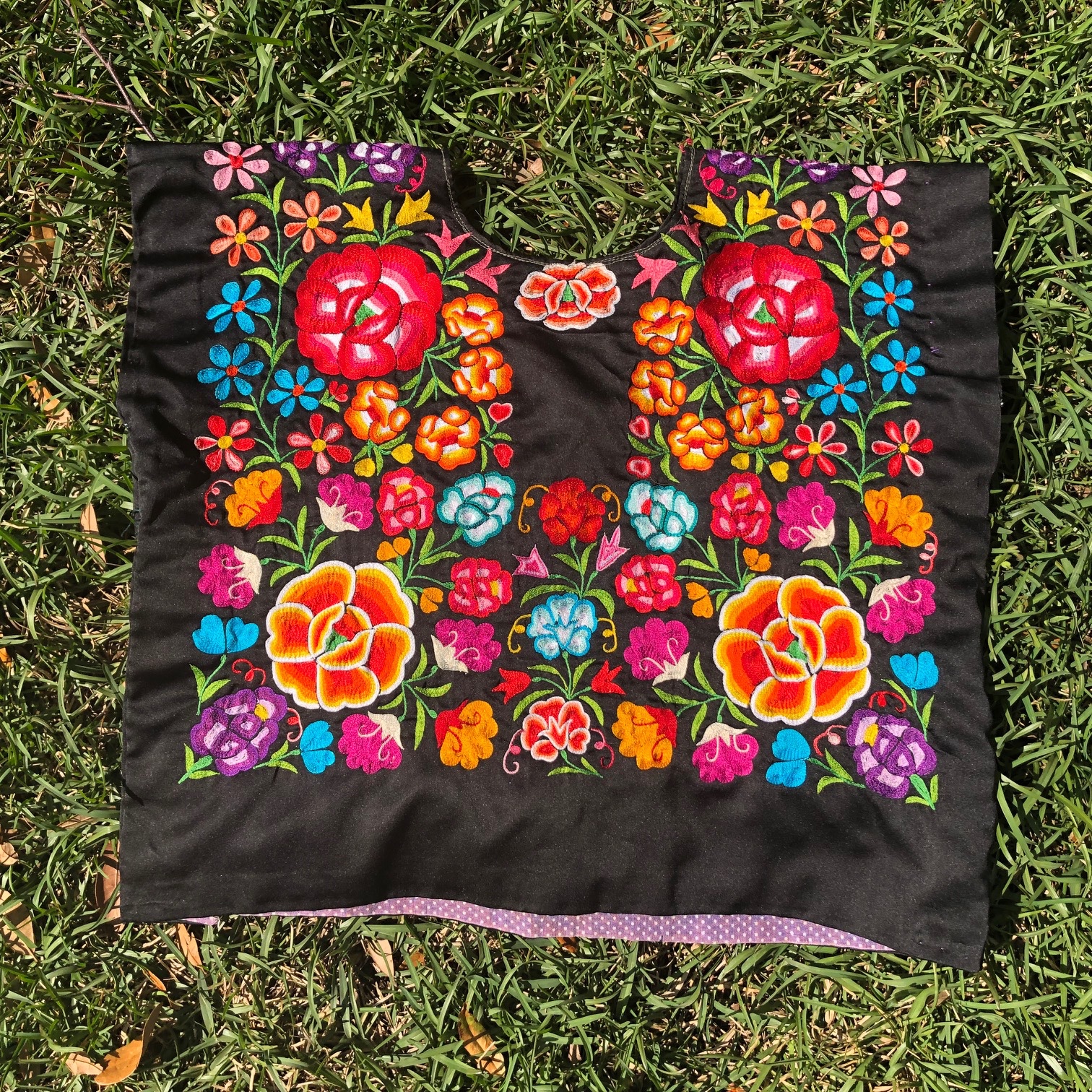
Here is one I purchased in San Miguel d' Allende, but it is a special use of the huipil execution called "tejuana." Tehuana dress originated among indigenous Zapotec women on the Isthmus of Tehuantepec, in Oaxaca.  This one  is on satin with a cotton cloth lining. The colors and handwork are exquisite with most all the work done in chain stitch.  I think all colors look better on black; it provides a wonderful contrast.  In the article from the V & A above, there is a photo of women from Tehuana dressed similarly for a religious celebration.


Here is another purchased on ebay. It is on blue velvet, again with a cotton cloth lining.


If you are interested in sewing or embroidering/creating one of your own, the Victoria and Albert Museum recently had an exhibit entitled "Frida Kahlo: Making Herself Up" which showed Frida's clothing and personal artifacts, including this


Here is Frida in a huipil in New York City, photo by Nicholas Muray, one of her lovers.


The V&A has a pattern for a huipil which is available online, with options for a round or a square neck. The pattern was developed by Alice & Co Patterns. 

Interestingly, as part of this year's Quilt National, there is a class in using a shirt to tell a story; the basic template is a huipil. Here is the basic pattern at this website.

And...as long as we are talking Mexico, here is a wonderful song to hum along with as you sew, featuring the fabulous Natalia Lafourcade along with Emmanuel Del Real,  a clip from a great movie,"Hecho en Mexico." Natalia has been known to adorn herself with beautiful traditional-inspired Mexican clothing.


Saturday, February 23, 2019

Thoughts on Socks, and Custom Woolen Mills Mulespun Yarn

Once upon a time, I said that I would like all the socks in my sock drawer to be hand knit. Since then, I have learned that this is just plain silly.

I have knit socks from Koigu, the best yarn of all. This was from the inspiration of a famous knit blogger and it was silly. Holes were had quickly...and I live in a warm climate where socks are only needed 6 months or less of the year. Koigu is for many beautiful things, but not socks.

However, I have a son who likes outdoor sports and needs wool socks. I have bought him and his brother buffalo wool socks from here, and they have been a hit.

And then...I went to Nova Scotia last May. Visited  "The Mariner's Daughter" in Lunenberg,  My travel friend Barb and I spent a long time in there. 


I found some great wool for socks. It is from Custom Woolen Mills in Alberta, where my good travel friend Barb who was with me hails from. The yarn is   Custom Woolen Mills CWM Sock which is 4 ply,  mule spun. It is a dk weight. It is a blend of Merino, Rambouillet, and Dorset with 30% nylon. The colorway is "Ewe Reek of Teal."  "Mule spun" refers to the  spinning equipment which  can use a long draw technique, resulting in an soft yarn full of air, similar to what can be obtained from hand spinning with a woolen technique. The spinning mule at CWM is from 1910. 

Here's a nice blog post with some information on woolen spun and mule spun yarns. 

Here are the socks  (well, one of them) done for my son, B. He promises that he will handwash them.  The pattern is a standard sock pattern of my own, gauged to B's foot measurements. Now, this is a good sock yarn. 


I am hoping to visit CWM on a future trip to Canada!


Friday, January 11, 2019

Continuous Strand Weaving (Trilooms and others)


Sammie makes a point of sitting on a loom. Maybe it's warm, maybe it's the texture. Maybe it's because it makes her look skinny (she's not)


Continuous strand weaving...defined..using a single strand of yarn as warp and weft on a loom made for the purpose with nails. No warping required. Looms can be triangular "trilooms", square, or rectangular.

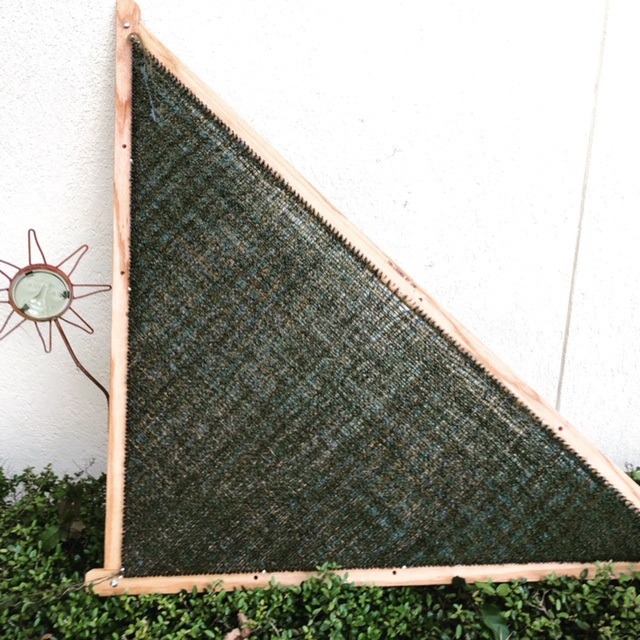
I spotted my first tri-loom more than 20 years ago, at the New Hampshire Sheep and Wool Festival. There was an immediate attraction, but it took me some years  to acquire one.  My friend who is a woodworker made me a large standing loom with a seven foot hypotenuse a couple of years ago.

I do however  also love working on a loom that is small enough to use while seated.  I also have a square loom that is a "lace" sett loom, with nails 1/4 inch apart. Here are some photos from the last several years of my continuous strand weaving adventures

Here is my 26 inch square loom, which is a lace sett. I purchased it from this guy who is a master at making these. I bought it to make myself shirts. This project involved one strand of silk and another of a slightly loopy cotton.


My plan to make shirts worked wonderfully. The bias weave is very comfortable!


Here are some small views of my 7 foot hypotenuse standing loom, made by my friend Greg. It has a half inch sett and is lovely for heavier yarns. This project involved handspun Sari silk which was plied with Aunt Lydia's crochet cotton, for strength.  I spun the Sari silk myself, and bought it here.  It made a nice and large shawl.  I have made several large shawls on this loom and they are all lovely.


I recently acquired another lace sett square loom, with a 4 foot hypotenuse. I am having fun with this. Here are photos of a project involving some loopy mohair that has been in stash forever as it is impossible to knit with...


I am exploring the idea of a child's sweater...


Here is another piece on this loom  with some natural dyed wool, where it came from I don't know. All the yarn is manipulated by hand...under and over. I love the tactile quality of the weaving process!


I have a small one with the same sett that I use for sampling to make sure that the product will come out as conceived...there is some takeup once it's off the loom. The way that I am weaving, it seems to be about 5%; so the finished fabric is denser than on the loom.


Sunday, December 16, 2018

Antique Fiber Tools at the Salzburger Society, Ebenezer GA

In my online quest to learn more about silk producation in colonial Georgia, I stumbled onto the website of a small museum, part of the Salzburger Society.

I knew nothing about this small colony of Austrians who emigrated from Salzburg because of  religious prosecution in the early 1700's. Salzburg was Catholic, and this group of people were Protestants.

With the support of George II of England they emigrated  when Oglethorpe was looking for people to come to the new colony of Georgia.  The original colony did not do well as it was too far from a place to resupply; it was an eight mile hike to the Scottish settlement of Abercorn. George II was happy with this group of pious, hardworking and non slave holding Germans, and granted them an area to resettle on the bluffs over the Savannah River, north of Savannah.


They built a beautiful church from Georgia clay called the Jerusalem Lutheran Church. Among other pursuits, according to this site indicated that  widows and orphans operated the first silk filature in Georgia.

It was about an hour drive from my home to Ebenezer GA, in Effingham County.  We were received by Patsy, the curator, who gave us a personalized tour.


A "sideways" stitching sewing machine


An Irish spinning wheel...interesting...