Saturday, January 18, 2020

Square continuous strand loom weaving: child's jacket

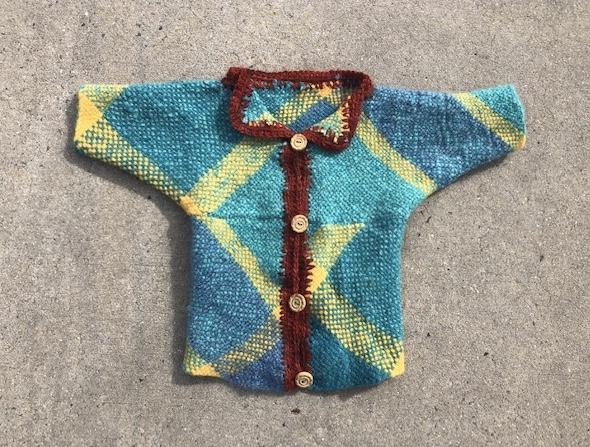
I don't live where it's very cold but I love working with wool. I had purchased my 28 " square loom to do warm weather tops for myself (and I've done one), but this winter I tried something with wool yarn from my largeish stash for donation. Here are some sort of directions and photos:


I completed a square, it was woven with worsted and heavy worsted and I wove tightly so the end was a squeeze. Of course the most woven warp threads really tighten up a lot. 


 I was afraid that the weave would be too loose but it wasn't. I impulsively put it in the washer and dryer to felt it a bit. I was very happy on removal from the dryer. It would up at about a 20 inch square. Remember...you can felt more but you can't felt less...start in the washer with a short cycle and warm, not hot, water. If your fabric is not felted enough, repeat and try the dyer.

I made some strategic cuts, now that it was a bit felted it did not fall apart. At the top, opening for the neck, neck slit 1/3 of the way down, and arm hole openings 2/3 of the way down. 


Folded over thus


I sewed the front horizontal seams using a zig zag for reinforcement. I also zig zagged the other cut edges. Then, I crocheted  around the front openings and neck. Added buttonholes in my crocheting. 

Finally, I turned it inside out and made a seam to narrow the sleeves and pressed the little collar opening.  It is a US size 3-4.  Very little waste...4 triangles where I cut to fit the sleeves . (not enough to add a hood, unhappily).

Very proud of my warm little wooly jacket which will be going off to the Salaam Cultural Center for "Hats and More for War Torn Syria" pretty soon. 
Thursday, December 12, 2019

The Galway Shawl

I spent much of last weekend doing a photo album for my trip to Ireland in 2016.  I recalled being taken with woven woolen shawls that I just learned are called "Galway Shawl." These were worn all over Ireland but perhaps were called "Galway shawls" as they they were shipped to Galway for finishing and distribution...the boat journey from Paisley, Scotland to Dublin would have been shorter...

I watched "The Quiet Man" in preparation for this trip. I was pretty appalled at John Wayne's character's treatment of Maureen O'Hara's character, but that notwithstanding, I did notice the shawl that O'Hara was wearing throughout the film


 I know that the filmmakers worked to clothe the actors with locally sourced garments for authenticity. While the shawls were worn all over Ireland (and long before the movie), many of the costumes for The Quiet Man were sourced in Galway. O'Hara kept her shawl in her home after filming the movie. 

According to wikipedia, these shawls were heavy weight garments for cold weather and became popular in the late 19th century and, according to this article, were worn until the 1950's.  I think that it's important to remember that for many cultures, a warm wool shawl was the only existing "outerwear" for working class women in northern climates for generations!

These shawls were produced on hand jacquard looms in Paisley, Scotland, with a cotton warp and a botany wool weft.  (Yes, Paisley, Scotland is where they wove paisley wool shawls but that's another story!) Botany wool is merino and may at the time have been sourced from Australia. Wikipedia says that they were sometimes called "velvet" or "fur" shawls because they had a soft nap. Some shawls were shipped from the Paisley Mills to the Galway Woolen Mills where fringe was finished.  They look to be square in shape and worn folded over. The colors appear to be mostly natural wool color which makes sense given the time period and the fact that dying, whether natural or chemical (available in the late 1800's) added to labor and cost.

While at the National Museum of Ireland-Country Life in Castlebar I saw some samples, through the glass of course...


Where would our material history be if it weren't for museums like this?

Wikimedia Commons provides some available old photos of these garments 


Below is a wonderful photo from the Galway City Museum that contrasts class differences in outerwear for women in the 19th or early 20th century.   During my Ireland trip I reread Frank McCourt's Angela's Ashes.  In the book McCourt recounts that no matter how poor they were, his mother Angela always wore a coat rather than a shawl as it signified working class poverty. I find the look in this photo on the wealthier woman's face to be quite telling.


The incredibly difficult life of working class women has been romanticized in the old Irish ballad "Galway Shawl."  Here's a version by Philip Noone


Saturday, October 26, 2019

Colombian Spindle Whorls

In 2017 I went to Bogata Colombia to visit friends. A trip to the Museo del Oro, the Museum of Gold, revealed many treasures. Artists have been working in gold in Colombia for 2500 years. 


Equally as enchanting to me were the ancients spindle whorls, alas not gold.  One of the explanations hinted that the whorls were cast using a lost wax technique, but they look like engraved ceramic to me. If you know, please get in touch!  The display noted that both sisal (from the agave) and cotton were spun and used to make fabrics and functional objects, although I learned that fique, which is similar to sisal, was and still is cultivated to spin a strong fiber twine.


Saturday, September 28, 2019

A Trio of Triloom Cowls

I don't like the word "cowl" which I think is a modern concept for a neck warmer; the original garment referred, according to wikipedia, to the hood of a monk's garb. I also don't like "shawlette" but these are one or the other! All of these are recent FO's. I was happy that my friend was willing to model them. I added buttons to all to make them easy to keep on...

All are done on my "lace dent" Triloom by Jim who makes fine looms.  His looms are available on ebay.

This one is doubled over loopy mohair; you can't see the fine gold thread running through part of it


I got spontaneous with this one and did a lace pattern, clasping the threads after weaving it.  This is mohair. I am fond of both loopy and nonloopy mohair for triloom weaving as it does not smoosh apart (i.e. loose the evenness of it's weave) with an open weave. I wove this one while evacuated for Hurricane Dorian. I don't often name my weavings but this one is of course "Dorian." See the little tornados?


This one I will keep; it is woven from a glow gradient merino silk roving from FiberOptic Yarns. I plied it with thread (it wouldn't have held up on the tension of the triloom without it) and then wove it with a strand of good old Aunt Lydia's crochet cotton. 


Sunday, August 25, 2019

Cold Harbour Mill and some thoughts on mills

May brought for me a fiber tour of Cornwall; on our way there my tour group stopped in Devon. We visited Cold Harbour Mill which is a working museum in Uffculme, on the River Culm. Cold Harbour is one of the "oldest working mills in the UK having been in continuous production since 1797" according to their website.   It was a two  and a half hour ride west from London just off the M5. 


We had a lovely lunch before the tour. I did not have ONE BAD MEAL in England. I think that the bad food reputation is due to the privations during and after WWII .  Here is the pub scene at noon on a Sunday. My lunch was excellent.


Then on to the mill. It is in a lovely setting and is well maintained. 


I try to listen closely to a tour guide when touring mills but I still don't understand what exactly all the machines do. But I think they are all very ingenious and beautiful. 


Puttees were made in this factory... the company had a steaming process that helped puttees mold to the legs. I was surprised at the number of countries in which they were worn. But then of course, the British empire and the influence on current and past holdings was immense, and I suppose that the puttees were a practical way to dress in many unfriendly environments.  


This was the air raid room for use during WWII


I always think of the poor people, often children, who were probably considered lucky to have jobs in these places, spinning cotton and wool into threads with little or no safety concern.  

I found the BBC program "The Mill" on Amazon prime, which has given life to this setting for me. The irony that the mill owner's wife was "antislavery" and yet the child workers were beholden to work in the mills is the ironic touch.


Thursday, August 1, 2019

FO: Elizabeth Shawl from North Ronaldsay Sheep


I have probably noted before that sometimes yarn must sit in stash for a while before it tells you what it needs to be. Such was the case with this yarn purchased on North Ronaldsay. It was sheared from North Ronaldsay sheep ON North Ronaldsay. The yarn was also processed and spun on North Ronaldsay.  The sheep are special and supposedly their wool is soft because they eat seaweed.


 I went to Scotland 10 years ago...I've been waiting THAT LONG for this yarn to tell me what it wanted to be.  It has been cast on and then frogged for perhaps 5 projects before this one.

North Ronaldsay is one of the islands in Shetland.  We took a day trip there during the tour, taking a small plane from Lerwick. The pilot looked a bit like Clooney.


When I buy a yarn from a different country, I want the yarn to speak to me, and either the yarn or I express the need for it to be something related to that locale.


I ran into Dee O'Keefe's Elizabeth Shawl a while back. I actually first tried this yarn in Dee's Elizabeth Wrap, but it didn't seem right. (A triangular shawl, while not traditional, always seems right.) The shawl has traditional Scottish lace patterns.

The yarn is soft and has the usual nice wooly spring to work with. I started it before a trip to England in May. Perhaps I was inspired because I was with the same tour guide as on the Scotland trip!

The yarn is a two ply fingering weight with a gauge of 4 sts per inch. I love this shawl.