Saturday, July 4, 2020

Processing Alpaca for Spinning Using Viking Combs

I am so thankful that the Tour De Fleece is happening. For those of you who don't know, the Tour de Fleece is a parallel event to the Tour de France, and challenges hand spinners to spin together with the cyclists. This years Tour de France has been postponed, but the Tour de Fleece is on schedule! If you want to learn more, check out the Ravelry group.

In preparation for it, I decided to prep some alpaca fiber for spinning. I am fortunate to have fiber from various sources at home.  Animals whose fiber was not long when they are shorn requires a different type of prep. I have some that is only 1 inch long, for some reason. This animal was not raised for  fiber use, at least not this year.  

Here is a photo of the results to keep you reading...


I have drum carded alpaca it before but did not love the results. When my friend was at my house for a distanced fiber fun day last month, she brought her combs. I've always been fascinated with those mean looking Viking combs. I had a chance to try them out at John C Campbell long ago.  So, I tried them out on the alpaca. It's a good match...at least for me. 

I have been lucky to get fiber for free. Some people keep alpacas as pets and aren't interested in the selling the fiber once the animals are shorn.

First, fiber is washed. Some fiber is dirtier than others. And, there are varying amounts of vegetable matter ("VM") in the fleece. That sounds bad but it just refers to straw! Unlike prepping sheep's wool, you don't need to worry about lanolin.

I wash in the kitchen sink (I don't have a sink in my garage or else I'd do that) with a 5 gallon bucket. I put a fair amount of fiber in the sink (1/2 lb maybe) and fill with warm water. Then I add about a tbsp. of blue Dove.  I let it sit a few minutes, maybe swish it around a couple of times. Then I drain. Add more warm water, and let sit a bit, swish, and drain. I do this until the rinse water comes out clean, perhaps 4 or 5 rinses.  It then goes into a strainer for dripping. 


You can see in the photo below a fair amount of VM in it, although the dirt is pretty much gone.


I squeeze it out; it then it is spread onto a sweater rack for drying.  Drying in sunshine is best as it is faster than indoors. 


Once it's dry, the combing starts. Combing is fairly time consuming. There is a fair amount of waste involved, i.e. the shorter fibers go either in the trash or into the pile of fiber for stuffing hand knit stuffed animals. But it give you wonderful combed "top" for spinning. Combing is also great because it removes a lot of the VM; it falls onto the floor or into my lap. There is extra vacuuming involved.   Here is a before and after photo.  These are "double pitch" combs with 2 rows of teeth. but the main thing is...safety first. When I'm not using the combs, they are put away and stored between  fat flat foam sheets.


How is it done ? Here's a good youtube video. I think everyone's technique is a little different.


And here are some different colors in beautiful puffs of combed top and the resulting yarns.


My yarn is double plied and pretty hefty, probably a heavy worsted weight.  

Thursday, May 21, 2020

Museo de Trajes, Bogata: Traditional Clothing

The Museo de Trajes or Museum of Costume in Bogata, Colombia was a great visit for a fiber  enthusiast like me.  I was lucky to see the exhibits  during a visit in 2017.

The posters (in Spanish of course) gave explanations of the goal of the museum, which is part of the  University of America.  Here is the essence of the posters in italics

The museum was founded in 1975 by the anthropologist Edith Himenez de Munoz. It is a place where costume and dress come together with consideration of the past, present, and future of costume. Pre-Hispanic dress and the European costume arrived with the Spaniards, and the resulting dress represents the mixing during the colonial times of indigenous peoples, Spaniards, and African population.
Also presented is the meeting of textiles traditions and crafts related to dress making, such as looms and various techniques present in America and others in Europe.


The Spanish explored Colombia in 1500 and began settlements early in that century, beginning with Santa Marta, Cartagena, what is now Sante Fe, and Cali.


The Spaniards found a textile industry in full development in various regions of the Colombian territory. During the colonial period they promoted it, but also quickly imported their technology: the sheep, the winch(?), and the treadle loom, which allows production of fabrics of greater length than the indigenous frame looms. They also introduced shearing tools for sheep, and the fulling units where fibers were washed, carding tools, and spinning tools. They also took advantage of textile fibers (of the region) i.e. American fibers and the craftsmanship of the natives to meet their needs; they introduced among others the industry of espadrilles, "pieces of the mounts" (possible reins), sieves, canvas, and sacks. Since the end of the 16th century, in the Cundiboyacense highlands and the Narino sierra, the indigenous peoples were forced to weave woolen cloths. In Santander the artisans, natives, adapted the European tools to the cotton fabric and later to work with fique (sisal)

another poster noted that

The clothing speaks of the colonial regime, and ethnic and cultural mixing of the population. The Spanish crown appointed to its representative exclusive garments which were symbols of power. for whites, mestizos, black slaves, and natives. Many garments worn by the mestizos were simplified versions of the Spanish costume of the 16th and 17th centuries. These were made from natural materials: embroidered shirts, skirts, knee pants, and hats of vegetable fiber or felted wool and espadrilles. Other items like the ruanas, the muleteer (shoes of rope?), and the poncho, were closer to the pre-hispanic textile traditions. Wardrobes were created in the various geologic regions and adapted to environmental conditions. Traditional costumes in the museum were typical in Colombia up until 150 years ago, when development of roads plus industrialization allowed rural areas to be connected to national markets.

Here are samples of clothing from the exhibits, beginning with earlier indigenous costume. Photos were permitted, but of course were through glass.


Note the molas used in costumes below; molas are thought of as Panamanian but are also made in Colombis


It's interesting to note that the embroidered blouses,  were a derivation of the "chemise" brought by the Europeans. I am fond of these garments that remind me of the embroidered "peasant" smocks that I wore in the 70's and 80's, a modern day garment-descendent


Saturday, April 25, 2020

Ukrainians in Canada: The Ukranian Cultural Heritage Village; Ukrainian weaving

I love museums. When I travel (and when I don't) museums teach me so much about the culture and heritage of a place or a person. Museums, like churches, contain bits of people's souls. (I didn't come up with that, I wish I could remember who did). 

When I travelled to Alberta to visit my friend Barb in 2017, we made a quick decision to go to the Ukrainian Cultural Heritage Village. Ukrainians have been recorded as beginning to move to Canada starting in 1891, although it may have begun earlier than that, according to Wikipedia. Ukrainians comprise an East Slavic ethic group; one name for them is "Cossacks." They by and large Eastern Orthodox Christians. More from Wikipedia:  Canada has the third largest Ukrainian population in the world following Ukraine and Russia. There were of course political "push" factors encouraging immigration, as well as "pull" factors, notable Canada's desire to populate the unsettled areas of Manitoba and Alberta, although Ukrainians also emigrated and stayed in the eastern provinces as well. 

So when visiting Barb and driving around Edmonton, we made a quick decision to go to the museum. The museum was impressive with reenactors, and the different buildings represented different time periods of Ukrainian immigration. It was a wet rainy day and these arches were very welcoming.


Of course, we arrived at lunchtime and proceeded to the restaurant for a Ukrainian-Canadian feast of a lunch. I wish I could remember what it all was but it included kasha salad and some sausage. 


Here, Barb inspects a loom housed for renovation in a barn.


The weavings were stunning, bright and colorful. I am not sure whether what I photographed were kilims per se;  here is a site with information on Ukrainian kilim weaving.  (It's a nice read, regardless).


There were some lovely embroidered garments as well; this may have been a wedding blouse


Here is the church; I love the three crossbeams on the Russian Orthodox crosses. They can be seen throughout Canada especially in the west


This is St. Barbara


In one house, this young lady showed us a dress that she had sewn "for her sister." She had a credible Ukrainian accent but came "out of character" once on the porch to give us directions to our next stop as it was pouring rain. This home was circa 1929. 


  This Singer Electric sewing machine would have arrived on the train from the East.


 The town store, circa 1929


Trains were present in the early 20th century in rural Alberta.


It was a wet and muddy day but worth it! Barb made pierogies for breakfast the next morning!

Artist William Kurelek, one of whose works I saw in Halifax a couple of years later, is Ukrainian Canadian. I liked this painting so much I photographed it


Monday, April 20, 2020

FO: Cathedral Grove Shawl

I have a good friend who loves the KAL. We had two shawl KALs between us over the last year. Perhaps I will finish the first this year. The second however is done.  It is Romi Hill's Cathedral Grove.  I do love a good lace knit. It does feel like my happiest knitting place (if not the most functional sort of project...that leads me to not thinking about how many lace shawls I have finished...). The dark yarn is Malabrigo Sock, color Pocion. The wonderful rosey orange,  I have not clue. I had just enough to finish.


OK, that's it for now...I am not working at present and should have time to knit  but the garden keeps me busy, and I am determined to be a better iris gardener this year. Here is my first open of the year:  Iris Siberica, Caesar's Brother


Monday, March 2, 2020

Clementine Hunter

I visited the Gibbes Museum of Art  in Charleston this weekend and was delighted to see a work by an artist who I find inspiring.  The exhibit "Central to Their Lives: Southern Women Artists in the Johnson Collection" was featured.   The Johnson Collection is a gallery in Spartanburg SC, not far from where I grew up in Greenville.

Years ago, like more than 20, I went to New Orleans on a work trip (long after I had left Greenville for college and points beyond...my job was in Manhattan). I visited The Quarter Stitch, which at the time had more needlepoint than knitting. Looks like Katrina could not keep this shop down. At any rate, this visit was years before Katrina. I was doing more needlepoint than I am now.

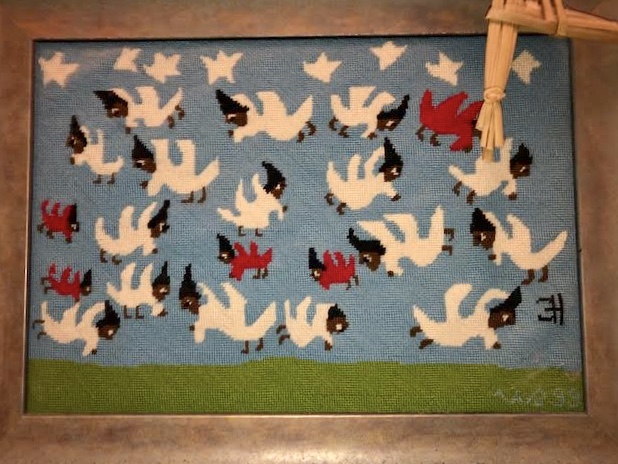
I spied several needlepoint kits that I thought were fabulous, they are reproductions of work by Clementine Hunter.  Hunter was born in Louisiana, the daughter of former slaves, in 1887. Now I have loved "primitive" art for a long time...starting with Grandma Moses who is geographically close to my family's Vermont roots. Mom had a print of hers when I was a child; I think that started it.  I also love Maude Lewis.

I purchases two needlepoint kits, now mind you, this was back in the late 1980's. One is finished.
I can't remember the name of the painting, but I recall that the little angels are white and the little devils are in red! (There's a bit of St. Brigid's cross hanging in front).


Here is the one not yet done...make not mistake, I like to stitch, I just have too many projects.  I just checked the date on the first... 1999. I'd better get to work on this next one!!


There is a lot of Clementine Hunter swag around these days, I've seen some lovely pottery. I spotted some at the Mint Museum in Charlotte last fall and here at the Gibbes. I myself couldn't resist the absurdly priced tea towel...made in India...


My bookshelf also contains a book about her which I need to read...


Thursday, February 6, 2020

LARGE Continuous Strand Afghan


Finally done after two years and many challenges. I purchased a used 5 foot square loom a couple of years ago. This was completed for the friend who made my 7 foot triloom. The yarn is Lion Brand Hometown held double for a thick fabric. I don't think I would undertake a similar project without using a natural fiber.

Here it is on the loom which was on and off my dining room table for two years. Towards the end, I could only do a couple of passes at once because of all the reaching. (I don't have back issues and don't plan on acquiring any!!)


Uneven weaving, probably due to the thick fabric and too tight weaving (hard to get it loose enough on this big a project), prompted a diagonal seam when I couldn't complete weaving on all the nails which you can see in the photo below. (Thank goodness for my trusty Janome). This resulted in a diagonal fringe on the wrong side which I kind of like. This project was a learning experience. Finished afghan is 4.5 feet square. I do love the colors!


Saturday, January 18, 2020

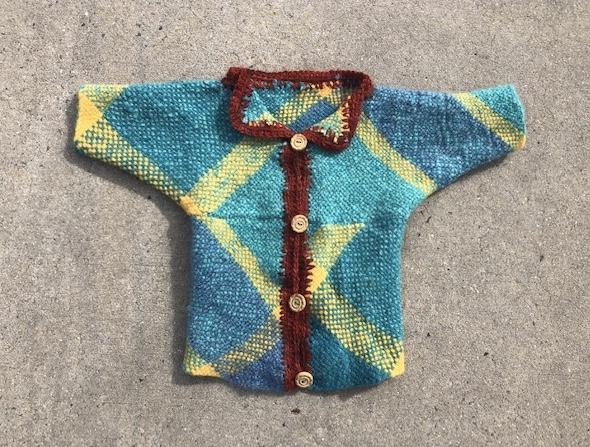
Square continuous strand loom weaving: child's jacket

I don't live where it's very cold but I love working with wool. I had purchased my 28 " square loom to do warm weather tops for myself (and I've done one), but this winter I tried something with wool yarn from my largeish stash for donation. Here are some sort of directions and photos:


I completed a square, it was woven with worsted and heavy worsted and I wove tightly so the end was a squeeze. Of course the most woven warp threads really tighten up a lot. 


 I was afraid that the weave would be too loose but it wasn't. I impulsively put it in the washer and dryer to felt it a bit. I was very happy on removal from the dryer. It would up at about a 20 inch square. Remember...you can felt more but you can't felt less...start in the washer with a short cycle and warm, not hot, water. If your fabric is not felted enough, repeat and try the dyer.

I made some strategic cuts, now that it was a bit felted it did not fall apart. At the top, opening for the neck, neck slit 1/3 of the way down, and arm hole openings 2/3 of the way down. 


Folded over thus


I sewed the front horizontal seams using a zig zag for reinforcement. I also zig zagged the other cut edges. Then, I crocheted  around the front openings and neck. Added buttonholes in my crocheting. 

Finally, I turned it inside out and made a seam to narrow the sleeves and pressed the little collar opening.  It is a US size 3-4.  Very little waste...4 triangles where I cut to fit the sleeves . (not enough to add a hood, unhappily).

Very proud of my warm little wooly jacket which will be going off to the Salaam Cultural Center for "Hats and More for War Torn Syria" pretty soon.