Sunday, August 25, 2013

Indigo Dyeing Part Deux

So, in my last post I described Tamara's workshop using a one time dye bath with kit.

Now that I had some idea of what I was doing, my friend J and I undertook an indigo dyeing project using a more chemically-based method for a dyepot that would be reusable


Note the disinterested cat...not a bad thing.

We used Jacquard Products Indigo Tie Dye Kit as we had at the workshop only this time we used the included reducing agent.  Here's J stirring the pot


After introducing the pre moistened fiber, you have to move it around carefully so as to not add oxygen to the dye bath until you're ready to remove it


The fiber comes out of the dyepot green and you watch it turn blue as the indigo oxidizes (combines with oxygen in the room air). Here's a before and after of some handspun cormo from Jupiter Moon Farm


The plies of  my two ply chunky did not take up the dye evenly so there's a subtle barber pole effect

J is planning to cut up some TARN (that is, tee shirt yarn) and dyed some tee shirts  (when I looked up tarn it turns out that "tarn" also means a mountain pool...appropriate that she was dyeing it blue)


In Wales my friend L purchased some laceweight BFL and silk from Bluefaced Yarn Shop  for me to dye for her.  This turned out the best, because the silk took the dye so well and it is lovely and shiny.  Yes, I did get it back into a skein but the takeaway was...tie up those skeins with several extra ties before dyeing!


We pretty much exhausted the dye pot but will do this again!

And finally, here is a video on how to cut a tee shirt into tarn


Saturday, August 10, 2013

Indigo Dye workshop with Tamara

So since learning about Eliza Lucas Pinckney and her critical role in indigo culture in SC, I have wanted to try dyeing with it.  But as it's a little complex I put it off, and so when the Charleston Museum was sponsoring a workshop last month, I had a chance to get to experience and learn about it first. 


I would like to introduce Tamara, our fearless instructor. check her blog out KnitOasis.blogspot.com. She has recently posted on more indigo dyeing adventures. She also does knitting support!


First, if you try this at home,  I want to state  here...BE CAREFUL!  There are chemicals involved, wear gloves and eyewear and keeping pets and small children away is a MUST!

Some basics about indigo: indigo is not water soluble so for conventional use it is "pre-reduced" and turned into a product with the oxygen removed. This makes it water soluble.  Tamara our instructor used Jacquard Products Indigo Tie Dye kit, which contains indigo that is 60% pre-reduced. There are two options:

1) Setup a dye bath with indigo and water for a one time use bath

2) Setup a dye bath with soda ash and thiox to make a bath that can be used multiple times. These chemicals "maintain" the reduction over time. In this condition the dye is yellow-green on coming out of the vat and when fiber is removed it turns blue as oxygen in the air reacts with the indigo. As the indigo (molecules??) oxidize the dye becomes permanant.  (Shouldn't we have done a chemical equation for this in chemistry class as we were learning about Eliza in history class??!!)


We used option number one and here is a link for the  directions we used (which has both techniques described) , complements of the Earth Guild in Asheville.  The vats were setup for one time use, meaning that they were composed of just water and indigo.  The dyestock was blue in color. Tamara mixed up different amounts of indigo with  water and so some buckets had less amounts of indigo.  Then you could chose how many times you wanted to dip your fiber.  The poster above shows how the strength of the dye and the number of dips changed the hue. There was lots of rinsing between the dips.  


Here are some results


Of course, I wanted mine very very dark blue of my 3 hanks of yarn


I was very happy with the result!

The Charleston Museum also had a small exhibit of indigo dyed textiles  including this


and this


Thursday, August 1, 2013

Plarn and Green Thinking, Green Synchronicity

OK so this is not my usual artistic medium...however in this day and age we must make our art with what seems relevant, and useful

A friend of mine wanted to create "yarn" from plastic shopping bags... to make  a bigger and more reuseable  shopping bag.  OK...this sounds interesting. I had heard of this before.  I watched with interest as this project progressed

There is a special way to cut a bag in a long loop.  Friend J took advantage of this project to invest in   a cutting board and a rotary cutter.  (Always a good thing to have those around.  Most useful.  I use mine for paper.)  The test yplarn is done from a Walmart bag


Along the way it looks like a hula skirt


Knit it up


Wow! That's cute, it's "recycled grocery bag bag" available here

Of course, one can always spin one's plarn first. J gave me some plarn ribbons and I used my beloved Turkish spindle so that when J knit it up, she could just pull from the little cake that came off the spindle.


Would one call this an energized single?  I suppose so. No test knit yet from the single ply spun plan...however the great news is that J is wanting to learn how to spindle and make 2 ply plarn!

So... weird convergence happens...

I am hoping to get to DC later this year and was looking for museums to visit.  Naturally I thought of The Textile Museum. OF COURSE it will be closed when I hope to be there...however at their website I stumbled upon an online exhibit all about repurposing and... well...green functional artistic endeavors, (a la the recyled bag bag).


that's a screen shot, here's the link, which has a lovely online exhibit that you can view!

and here's a bit on youtube about the exhibit which happened live in 2011


And to make things REALLY SYNCHRONISTICALLY WIERD...Maximo Laura was one of the featured artists in this exhibit...it hit me when I looked at the online exhibit that I had visited his studio when in Lima Peru 3 years ago...here's his tapestry featured in the exhibit...


Here is a weaver from the studio (photo by me)


and here I am at the balcony at the studio...overlooking a cemetery that I suspect is Vergen de Lourdes in Lima


Saturday, July 13, 2013

Stor Rund Dug or Danish Doily Shawl

I had never done a circular shawl, but several months ago I found via Ravelry a website called Yarnover.net with a translation of a Danish doily called Stor Rund Dug, pattern here.  Babylon tells me that this means "large round tablecloth."  Thanks to the giving person who translated it...couldn't find a name.

There is a Danish site with directions in Danish, if you're interested in knitting from the original Danish...Kunststrike.DK but I couldn't get it to pull up.

After some centemplation I realized that I had the perfect yarn for this in stash....and Danish to boot.  The Isager Strik Tvinni Tweed seemed perfect.  This was purchased at Yarn Paradise in Asheville several years ago.


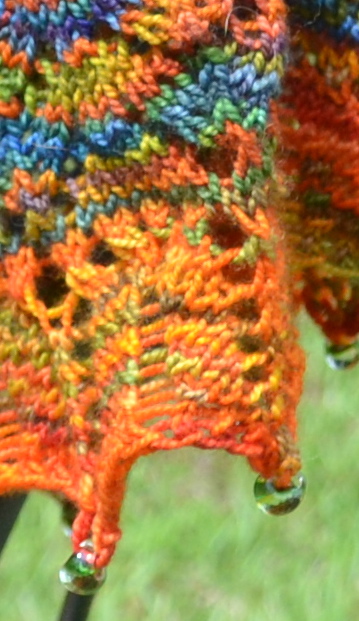
I ran out of yarn (only had two skeins) but finished it off with a similar yarn in stash (hence the slight brown color variation at the border) and an Evelyn A Clark traditional pointy bind off. I used some little jasper beads to pull the points down and make it hang nicely.

It's a perfect little "air-conditioning" shawl for cool mornings in the office.

My friend L says that this should also be called "Knitting in the Bars in Wales" because this was my evening knitting project while traveling in Wales!

Saturday, June 29, 2013

Wonder Wool Wales 2013!

I am five hours away from the closest sheep and wool festival, so I was delighted that Wonder Wool Wales was our first stop in Wales.  


Warning:  my photos were by and large quite lousy I don't travel with a computer for daily viewing and fixing..but maybe next time...

National Wool Museum Exhibit ...if you ever go to Wales I would HIGHLY recommend this museum which is in Dre-Fach Felindre, Llandysul, Carmarthenshire).


The Hattersley Domestic Loom (here's a nice read on this loom, while not a weaver I'm fascinated with this loom which I first met in Scotland on Harris)


Manx Loaghean


Wicker creations are local to Wales...this was a "weave some yourself" exhibit


This very talented woman was sporting a great hat which I got a very poor photo of...she felts birds and has added them to her chapeau...she gave me permission to feature this photo and her website ... of course I lost her card with her site information.  So sorry. 


Pembroke Poll Dorsets


Talis Kimberley, my new favorite fiber chanteuse (note the "Campaign for Wool" banner behind her)


Here's a youtube video of Talis and friends doing her big sea chantey style hit entitled "Can You Knit, Brave boys?"


Felting workshop (they will be mitts)


Fashion Show


Men in kilts and red tights 


And...the view behind the loo


Needless to say, I will be taking time off this year to get to SAFF in Asheville this year for some more local festivities!

Sunday, June 9, 2013

Welsh Stockings


Hello, are your feet warm?


Why yes, I went on a trip last month...I was lucky to be able to join Joyce James, fiber-purchase-agent- provocateuse on her journey to Wales, along with 13 intrepid fiber loving companions, one brave husband, and an intrepid coach driver. (In case you don't know, "coach" is UK and Canadian speak for "bus.")

The first post that I am inspired to do is on traditional knitting in Wales, of which, I don't believe, there is a tremendous history for my first interest...shawls.  I didn't happen upon any, although that's certainly not to says that shawl knitting didn't happen in times past in Wales.  If I were interested in hats, there is a knitted hat that supposedly originated in Wales, the "Monmouth Cap."  

 However, the  Welsh were well known for knitted socks or "stockings." Here is a lovely painting by William Dyce entitled "Welsh landscape with two women knitting" from 1860.


A bit of internet research turned up information from a museum that we visited,  Ceredigion Museum in Aberstwyth. This was a fascinating place, full of treasures from the past and located in a repurposed Edwardian era cinema.   Some highlights regarding socks from the this web page include:

Funeral stockings were commonly knit, very sweet with with bereaved's name knit into the stocking. 

Further digging at this website revealed another fascinating read by a woman named Sara Minwel Tibbott who was a writer and collector of information about domestic crafts The link is here. After more internet research (which I've decided that I might be kind of good at...) I discovered that the link is a chapter  excerpt from Sara's book,  entitled Domestic Life in Wales, which is a sweet read on daily domestic life in pre and just post industrial Wales. 

According to Sara, during the 18th and 19th centuries, knitting stockings (socks) were an important and sometimes (for single women) a primary income in households. Most women and many men when not doing other work had knitting in their hands.  Socks were then sold to individuals and at fairs, often to "stocking men" who then took their purchases to London.

Stockings used natural white at the top (the "welt") and toe. Colored or dyed yarn was used for the body of the stocking. Blue grey from the home dyepot was for men, women wore black stockings.

This cottage industry was outdated by the mid nineteenth century when the railroad allowed quick transport of stockings and other knitted goods from the factories in England and Scotland throughout the UK, although of course home knitting lived on.

So of course, all of this left me in search of a pattern.

Here is a  photo of  Nancy Bush's "Welsh Stockings" and the Rav link to it below!  I plan to adapt a sock pattern to this color scheme...


http://www.ravelry.com/patterns/library/welsh-country-stockingshttp://www.ravelry.com/patterns/library/welsh-country-stockings

Tuesday, May 21, 2013

Koigu PPPM Addiction

It's easier to come up with a great descriptive name for a yarn with a three word title for its addictive properties, e.g. "crack silk haze."  I'm trying to come up with one for koigu KPPPM...let me know if you have any suggestions.

So here's another:  the Oyster Bay Shawl by Lori Law.


For this type of lace I like a pattern with some regular knit 2 togethers/kps's and yarn overs to create kind of a scallop-y look.


Two shades of KPPPM.  And some little pyrex teardrop shaped beads for the border from my LBS (local bead store), High Tide Beads.


Prior to the edge I did a row of eyelets with just k2tog and yo, and then I came up with my own edge as the repeat had an even number of stitches, *yo, k1, yo, k2, skp, k2tog, k2* and purl wrong side rows...there was a visible strand between the skp and the k2tog which I liked.


Isn't orange grand?


(Not sure what this is, it was supposed to be an autumn bloomer, didn't do much, lived through the warm winter and now it's got it's energy.  This is only one stalk of this large plant.)