The Day of the Dead (Dia de lost Muertos) was Nov 1st. This is a day to honor one's deceased ancestors, which is a traditional holiday in Mexico and most Spanish speaking countries including Spain. The holiday is a synthesis of Catholic tradition and ancient Aztec tradition.
Being not Spanish speaking, Mexican, or Catholic, of course I had to I light my Catrina candle (purchased on a trip to Mexico). My Catrina wears the traditional marigolds.
(Ironically, I had unwittingly purchased some autumn blooming French marigolds for the pots in the front of my house on the 1st!!).
Evidently the first Catrina was La Calavera Catrina (calavera meaning skull) done in an etching by Jose Guadalupe Posada. This image has been incorporated into the Dia de los Muertos celebration in many ways.
And of course this image was used in Diego Rivera's famous Dreaming of a Sunday in Alameda Park, his huge mural in which he painted Catrina, himself, and of course wife Frida Rivera. Alameda was Mexico City's first park, built on a former Aztec ruin. I was lucky to see this mural during my trip, it is HUGE and located in its own building.
Here is a link to a detail from some nice photographer at flickr showing Diego's interpretation of himself, Friday, and Catrina
I did finish something on or around November 1st...this cute little sweater for my niece, a holiday gift.
The pattern is Fabled Cardigan by Terri Kruse.
I have spent WAY too many hours in the last couple of months re knitting things. Like, hours and hours and hours. For garments, I usually swatch, but even when I do sometimes things don't fit.
And even if something doesn't need a swatch I decide, despite 50 hours more or less of work on it, that it's the wrong size, or I'm doing the wrong item (scarf vs. wider dresser scarf...), I frog and reknit.
For example: I have some handspun which I did several years ago. Early handspun effort. I loved the colors by Gale in the initial roving, but once spun up the lavender tones were...well.. a little too dim and undecisive for me. (A nice way of saying that pale pinky lavender makes me nauseous, even when offset by yellow...). In an effort to destash, I pulled it out, decided that the yarn would look great in the Morning Surf scarf pattern. I had seen it in a 2008 issue of SpinOff and apparently it's now available for FREE! In the initial spinning I added some beads. It looked like dresser scarf project when I started the clever pattern, then realized that the beads at one end destined it to be a neck scarf. I've started this FOUR countem FOUR times in different widths. Hopefully now I've got it right.
The pattern does REALLY WELL at bringing one's eye to the unplanned color variations. Despite the fact that this is an early spinning effort, I will give this away.
SO with all the reknitting this summer and early autumn, it was with EXTREME PLEASURE that I FINISHED something. Son B requested a chullo in Clemson colors. Yes, Virginia, there IS a Clemson group on Ravelry!!
B has a large head, relatively speaking. (I also had to start this project several times but as it's bulky weight, it finished quick once I figured it out...). I found, thanks to Bernat, a top down chullo pattern. (All of the prior chullos in my life were bottom up...). The pattern is in this free ebook. Oh, thank you Bernat. Thus, I could knit until the crown fit B's head. He loves the photos I've sent...I'd better get it to him before football season's over!!
I am lucky to know three people (on two different trips) who have hiked the Inca trail to Machu Pichu in the last two months...as you might know, I myself merely took the train and the bus...
AND my friend Susan who I stayed with last weekend on a quick trip to Massachusetts has also been to Peru as well. Susan shared some of her handknit and backstrap woven purchases. I only had my camera to photograph with so the photos are not great...
I love the brilliant green and black hat and the motif of the second woven strip. Both hats are alpaca.
I did some internet searching and came upon this great thing
Apparently this was the garb of the Peruvian downhill ski team during the 2010 Winter Olympics. How grand! Wonder what the fiber was? Here's a link with more:
http://blog.oregonlive.com/knitting/2010/02/knitting_in_the_actual_olympic.html
While visiting Susan and Son R, R and I went to the MFA, one of my favorite places. I hadn't been there in years. The highlight of the visit was this
These are REAL taxidermied hummingbirds turned in to a brooch and earrings, done in the 1870's in England....The link to an MFA site with more discussion is here. You can't see from the photo, but the beaks are gold and the eyes, rubies. They look a little like scared hummingbirds with Buckwheat haircuts, don't they?
Ironically, after arriving back home, I was watching my feeders on the porch the other night. It was early dusk and I could see the red rim around the humingbird feeder but not the small thing flitting around it. (It's almost the end of hummingbird season here although I have an acquaintance who had one at her feeder all winter last year.) At first I thought it was a dark little skipper, but after a bit I realized that it was a juvenile hummingbird. Magic!
A couple of weeks ago I was reading an article on garden spiders in the Sunday paper.
I started looking at webs a little more in my yard and saw what I now know is a Spiny orb weaver and her web. I tried to take a photo (on automatic mode, of course) but the spider and its slender web were so fine that I had to go to manual focus. Got some lovely pics.
What a weaver she is! Does anyone else in nature weave their own fabric?
Meanwhile...visited a new yarn store in Savannah, The Frayed Knit, opened by my friend Jennifer, here's Linda out front. Of course, I bought some roving.
I would like to spin Linda's hair!!
So last weekend it was off to Clemson U for "family weekend," e.g., check out that your freshman is doing OK...
When I got my Rav4 last year, I thought that a cool spare tire cover would be neat, maybe something that said something about knitting. So, I went searching the internet. To my surprise, I found several crocheted tire cozies online and traced them back to some clever ladies at Ravelry. I did not find a knitted one in my search. I had just finished a circular shawl and realized that one of those patterns would work. I chose the Firmaments shawl.
When son B decided on Clemson, (and vice versa), it was obvious that orange would be the color.
When I finished it, it did not fit. (I was trying hard to get it to fit on 'round about midnight the night before the drive up...). A little orange duct tape is hidden from this view, but attests to the face that I need to get another skein or two of Bernat Super Saver in orange to complete it. It was held doubled for this project.
On arrival, another family member said that the little diamonds looked like tiger paws. I hadn't even realized it!
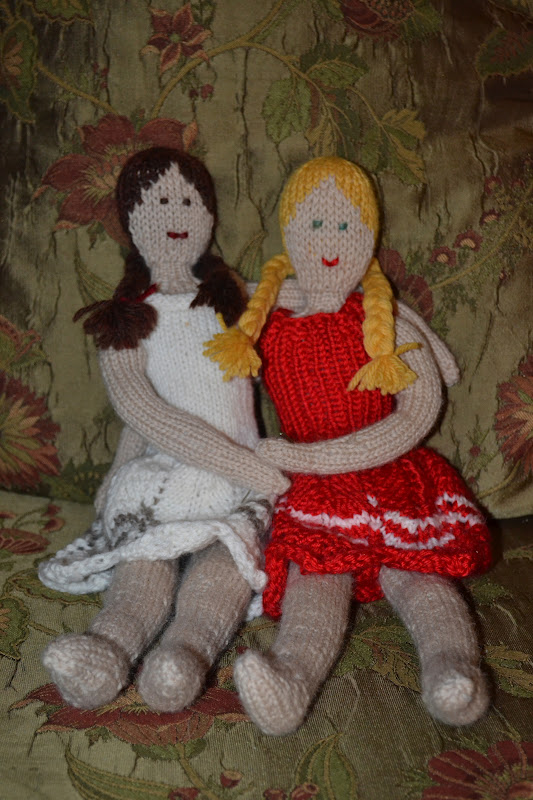
What to name her?
Actually, her name is up to the recipient. Yes, Theodora is a little "fiddly" to knit, but the results are really just too much fun, and there is so much room for creativity.
She doesn't mind showing off her bloomers
thank you Helene. She has a friend
I plan another friend for these girls...there are just so many cute variations to think of.
Do you think that a Barbie stand might be a great thing for them in case they would like to stand up for a bit??
I am interested in learning how to spin flax. I know that this is a huge part of our fiber heritage. Several of my favorite resources discuss flax culture. In the chapter on flax culture in Home Life in Colonial Days originally published in 1898, Alice Morse Earl discusses the importance of each American household being self-sustaining:
No farmer or his wife need fear any king when on every home farm was found food, drink, medicine, fuel, lighting, clothing, shelter. Home-made was an adjective that might be applied to nearly every article in the house. Such would not be the case under similar stress today. In the matter of clothing alone we would not be independent. Few farmers raise flax to make linen; few women can spin either wool or flax, or weave cloth, many cannot knit. (This was 1898 when she published this!) In early days every farmer and his sons raised wool and flax; his wife and daughters spun them in to thread and yarn, knit these into stockings and mittens or wove them into linen or cloth, and then made them into linen or clothing. Even in large cities nearly all women spun yarn and thread, all could knit, and many had hand-looms to weave cloth at home.
(This quote is on pp. 166-67 in the edition that I own which is copyright 1993 by Berkshire House Publishers).
Of course, Mrs. Earl is discussing this relative to colonial America, whereas she also makes reference to flax culture being at least 4000 years old, there being representation of flax culture in the art of ancient Egypt.
Note, linen is the fabric woven or knitted from fibers of the flax plant.
Of interest to me, of course, is her mention of early efforts at South Carolina flax culture which I discussed in a post several years ago, a section of which is quoted here:
It’s clear that flax culture was critical, as linen provided the coolest garments... Alice Morse Earl's excellent research for Home Life in Colonial Days revealed a letter from Major Lucas to Eliza dated 1745; in which he documented sending her via sloop (from the West Indies, presumably?) two Irish servants, a weaver and a spinner. He ordered flax seed sent to her from Philadelphia. The two Irish women were charged with training slaves to spin flax and weave clothing for the slave population. Eliza had spinning wheels and a loom made, and a "sensible negro woman and hundreds of others" had learned to spin. Mrs. Earl's followup comment is "excellent cloth has always been woven in the low country of South Carolina, as well as in the upper districts, till our own time" (p. 183) (e.g., again, a. 1898). She may have been alluding to the textile industry that is still active in upstate South Carolina).
Manual flax production from the plant has multiple steps, involves many tools, and is very physically demanding. Undoubedly, the small amount that I purchased recently from Wild Fibre was produced using some industrial process.
So...when my friend Deb was here, I got a tutorial. I was relieved to learn recently that my spinning wheel, an Ashford Traditional, is perfectly good for spinning flax. I needed a bowl of water at hand to keep the threads moist as I drew them out. It was very easy to spin a fine, if a bit uneven thread with a high twist. Now...to finish spinning and figure out what to do with it...