Sunday, March 9, 2014

Sandalwood Dyepot Recipe


There are only two things in life that I consider real-life chemistry experiments (my dear sister reminds me…cooking notwithstanding…).  The first is something that I will never do, that is, managing one's backyard pool chemicals.  The other I hope to do many times more: natural dyeing at home!

Sandalwood Dye Recipe

Safety note:  do NOT use any pots or bowls or stirring tools that you plan to return to the kitchen.  I renounce any responsibility if you do this either on purpose or by accident!

Mordant Bath

Ingredients:

1) 1 gallon of Bluffton South Carolina tap water (next time I would use warm tap water to reduce the time needed to warm it once in the mordant bath)

2)1 oz alum

.25 oz cream of tartar was suggested by one website, but I eliminated this as it also said that cream of tarter brings out more pastels but is easier on fiber so I decided to eliminate it…I preferred to not have the color toned down

I doubled the amounts of water and alum to give enough liquid to cover the wool in the mordant bath

3) Undyed wool from Ireland: 3 mini skeins 1.8 oz each or 5.4 oz total


Note: I used my dye-dedicated turkey roaster (henceforth DDTR) for both mordant bath and dye bath.

Directions: Preheat the DDTR or your preferred dedicated dyepot and mix water and alum in it, with a dedicated stirring tool. Premoisten the fiber and add, bring to a simmer.  Simmer for an hour then leave in the dyepot to cool overnight.  Parts of my yarn took on a silvery (alminumy?) tone.  The next day, drain. You can reserve the mordant bath for another mordant bath if you wish.


Dyebath:

2 oz (48) gm of sandalwood powder

Used this procedure:
Wearing a respirator mask, I mixed powder with alcohol to cover, I used isopropyl alcohol (I didn’t use much as I didn’t have a lot) to cover, next time I’ll use more

Let it sit 30 minutes then add to a quart of water in DDTR, simmer one hour.

Strain through a coffee filter.  I didn’t do this…the dyestock was so pale that I got nervous and dumped the paste in the bottom back into the depot!!

Leftover paste: 


Dyepot plus paste:


A note on amounts: One site said to use 1:1 weight of sandalwood to fiber, another said 2:1of sandalwood to fiber. I used what I had: 1:2.7!!!!

2 oz of sandalwood powder and 5.4 oz of wool (dry) 

Despite my trepidation I went forward and got what I thought were good results:
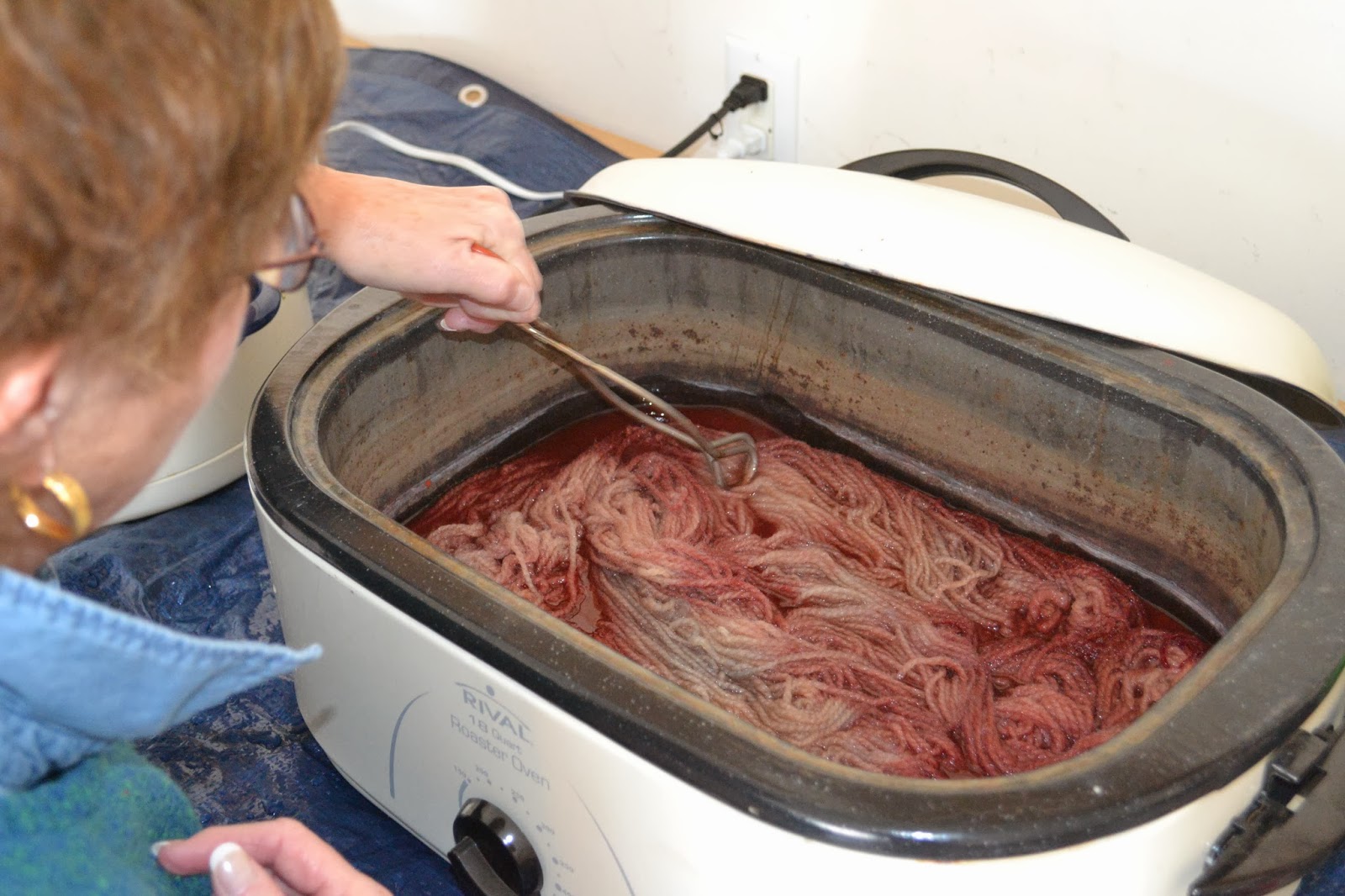


It did need some rinsing due to powder still in the fiber…it is a bit duller than the photo above but the Afghans for Afghans knitting crew here in Bluffton seems satisfied….


Some nice sites that I used to put this together include:


I thank these bloggers for helping me to formulate my recipe and understand that it’s all a big experiment!

I've added this post as a page for easy future reference, for me if no one else!

Sunday, February 23, 2014

Icelandic


I may have learned when I was visited Iceland that there was such a thing as a traditional Icelandic shawl.

After I visited there, I found a book English title "Three Cornered and Long Shawls"by Sigríður Halldórsdóttir (that's my name in my next life).


It is available from those nice people at School House Press, with of course English translation.

Helene has translated it into French (yes, I was a French major…no…I won't be needing it in French)

I love the natural tones, and last year I found Kauni Effektgarn (yeah, Danish not Icelandic) in natural tones.  Lazy as I am, I thought, that this would work nicely for one of these Icelandic shawls.  I opted to not go with one of Sigurdur's documented patterns, rather, one of Evelyn's, the Icelandic Poppy Lace Shawl


It's large and I rather love it


So in exploring more about Kauni


I find this


and this


and this


Yep, there might be more Kauni in my future...

Wednesday, February 12, 2014

A Lovely Gift

Having experienced joyful adventures in indigo dyeing, I felt the urge to do more natural dyeing. I love warm orange tones and bought some sandalwood dye powder from Dharma Trading. I also purchased some alum as a mordant, (although I did learn that one can make one's own alum using "tin" foil and a blender, no thanks…)

Simultaneous to this…I have lucky Sunday afternoons when I knit with J and S.   S  one day told us about a friend of hers.   Mary,  of Irish heritage, had purchased some lovely Irish wool and started a sweater. When  Mary became ill with cancer, she could not finish it.  S helped Mary to figure out what to do with her belongings (I mean really, can you imagine visiting your best friend in her last year and helping to determine the disposition the of all her precious belongings? What strength S has...).  Mary wanted something "good" done with the yarn.

S, fast to oblige, took the yarn and made the promise to her friend that she would knit up the yarn for good purpose.   Here's just a part of what she has from Mary's wool.  Unlabeled, soft and cozy


There is also a sweater fragment that we decided would make a fine hat with a bit of seaming


S has a place in her heart for Afghanistan. She wants to knit Mary's wool into items for Afghans for Afghans.  However the natural white of the wool won't do for this cause.

Clearly, a dying party is called for!

First step:

Clean the dye "studio"  lol  Before


After


second step:  find your respirator mask


(Yes, that would be me…reading glasses count as eye protection, no?)

Third step: setup dye pots of which there were three

Natural Sandalwood  (a lovely orange tone, I will do another post on this natural dyeing process)


Synthetic Acid Dye (a lovely Irish Hills green from Country Classic; used Key Lime with a little Teal thrown in to get a darker-than-lime green)


Natural leftover almost-exhausted indigo dyepot (a lovely ice blue)


here are some of the results


There's lots more yarn, will do again with different colors…now, on to knitting!


Tuesday, January 21, 2014

Icicles in Alpaca

In Peru, a couple of years back, I purchased some handspun alpaca while in Cusco in Peru from here


Do I look happy or what?  I'm suspecting that the yarn is in the bag.

Here is the label


Consa from Pitumarca handspun it. It's two ply. Cost, if I'm not wrong…$16.oo.  OMG. I might have to name my next cat Consa.  Consa probably speaks Quechua. My handwriting is on the left of the above label, I guestimated the yardage. Here is a map showing where Pitumarca is, southeast of Cusco.


So, I had to figure out what to do with it. Sometimes yarn must sit and pickup the vibes at my house before it knows what it's meant for.

A while back I saw a pattern in Knitters for Susana IC's Icicles Shawl.

It seemed to be right for this yarn.


I added green toned beads at the border.  I love the natural striations of the yarn.


So it was finished up last week.  Here's a lousy photo that is out of focus, but it gives an idea of the drape and potential.


An aside: there was leftover yarn so I knit Anne's "Spiraluscious."  The lace in both projects shows the yarn to advantage…


(Yes, sometimes there's the iPhone photo and sometimes the Nikon…neither are that grand this time 'round, though)

My church is having an exhibit of art done by those who attend.

On Saturday we hung the artwork.  I was pleased that my shawl was hung underneath a lovely oyster wreath done by my friend Cheryl; lovely natural tones from two parts of the world together…ignore the plastic hangers, please…)


Friday, January 10, 2014

If You're Cold, Put on a WOOL Sweater

My Mom went to Scandinavia in 1999.  She visited Tanum in the north of Bohuslan on the west coast of Sweden.


View Larger Map


Tanum is the location of the Vitlycke Museum, location of bronze age rock carvings or if you want three syllables, "petroglyphs."


(They all kinda look like JarJarBinks, no?)


A clever knitter and designer created sweater patterns from them.

And a clever Mom knew to buy some. You know, while Brenda says "if you're cold, put on a sweater"…my Mom says "if you're cold, put on a WOOL sweater." I guess that in the Bronze age, one would say, "if you're cold, put on a FUR!"


There was a hat, too.  She also bought a kit for me to knit for my little (at the time) sons (in the darker gray)


And then…some folks who I am related to, including the woman who is smart about wool sweaters...showed up for Christmas this year


(note the hat)

So I noted the label in Mom's sweater and did a web search


I found the designer!  She is Cecilia Bergil of Goteborg. Here is Cecilia's blog:

http://tollasstickning.blogspot.com

Cecilia's blog is in Swedish but her English is great too.

She has kits for sale if you'd like one.  Or better yet, go to Vitlycke and buy one in person…!